Let’s be honest. Most people don’t think about static electricity inside an industrial building.
It’s not visible. It doesn’t make noise. And unless you’ve worked in electronics manufacturing or chemical processing, it probably feels like a minor issue — the kind of thing that gives you a tiny shock on a dry day and nothing more.
But in the wrong environment, that tiny shock can quietly destroy expensive components, corrupt sensitive systems, or in rare but serious cases, trigger ignition.
That’s why ESD flooring exists. And that’s also why many facilities don’t realize they need it until they start seeing unexplained failures.
The Static Problem Nobody Sees
Static electricity builds up constantly in industrial spaces. You don’t need extreme conditions for it to happen.
A technician walks across the floor in safety shoes.
A trolley moves from one section of the plant to another.
Plastic packaging slides across a work table.
A conveyor belt runs for hours.
Every one of those actions generates electrical charge.
Now here’s where it gets interesting.
A human being usually doesn’t feel static discharge until it reaches roughly 3,000 volts. That’s why most static events go unnoticed.
But modern electronic components can be damaged at levels below 100 volts. Some microchips are even more sensitive than that.
So the damage can happen silently.
No spark.
No visible sign.
No immediate shutdown.
Just reduced product reliability or random failures later in the supply chain.
And that’s where businesses start losing money without understanding why.

Why Regular Floors Don’t Solve the Problem
Many facility owners assume concrete floors are “naturally grounded.”
Technically, concrete can conduct electricity — but only under certain moisture conditions. Its conductivity changes depending on humidity, surface contamination, age, and whether it has been sealed or coated.
On a humid day, it may appear to work fine.
On a dry day, static levels can spike.
That unpredictability is the real issue.
In industries like semiconductor manufacturing, pharmaceuticals, or hazardous chemical handling, unpredictability isn’t acceptable.You don’t want flooring that works “most of the time.”
You want flooring that works every day.
So What Is an ESD Floor, Really?
An ESD floor isn’t just a special paint or a marketing label.
It’s a flooring system designed to control how static electricity behaves inside your facility.
Instead of allowing charge to build up and discharge suddenly, the floor gently guides the electricity into the building’s grounding system.
Think of it like controlled drainage. When rainwater is managed through proper channels, it doesn’t flood the building. Static electricity works the same way.
A properly installed ESD floor includes conductive elements within the material itself. Beneath that surface, copper grounding strips are installed and connected to the building’s earth system.
The goal isn’t to eliminate electricity.
It’s to control it.
And control is what makes the difference between safety and risk.

Two Types — And Why It Matters
Not all ESD floors behave the same way.
Some are designed to move static quickly to ground. These are typically used in highly sensitive electronics manufacturing environments.
Others are designed to release static more gradually. This controlled dissipation prevents sudden sparks in areas where flammable vapors may be present.
Choosing the wrong type can create new problems instead of solving them.
That’s why assessment matters before installation.
Where ESD Flooring Is Usually Necessary
You’ll typically see ESD flooring in:
- Electronics and PCB assembly units
- Data centers and server rooms
- Aerospace manufacturing areas
- Pharmaceutical cleanrooms
- Chemical processing plants
- Battery manufacturing facilities
In these environments, even minor electrostatic discharge can cause financial or safety consequences.
But here’s something important — not every industrial facility automatically needs ESD flooring.
If you’re running a warehouse storing non-sensitive materials, you probably don’t require it.
If you’re manufacturing microelectronics, you absolutely do.
The decision depends on what you produce, what you store, and how sensitive your operations are to static interference.

The Cost of Ignoring It
Here’s where most companies start paying attention.
Static-related damage doesn’t always look dramatic. It often shows up as:
- Higher defect rates
- Intermittent electronic failures
- Reduced product lifespan
- Customer complaints
- Warranty claims
And because static damage can be invisible, it’s rarely the first thing people investigate.
Months can pass before someone identifies electrostatic discharge as the root cause.
By then, the financial loss may already be significant.
Compared to that, installing a proper ESD flooring system is a preventive investment.
Installation Is More Important Than Material
One thing many facility managers overlook is this:
Even high-quality ESD materials will fail if installed incorrectly.
Surface preparation is critical.
Moisture testing must be done.
Copper grids must be placed correctly.
Grounding connections must be verified.
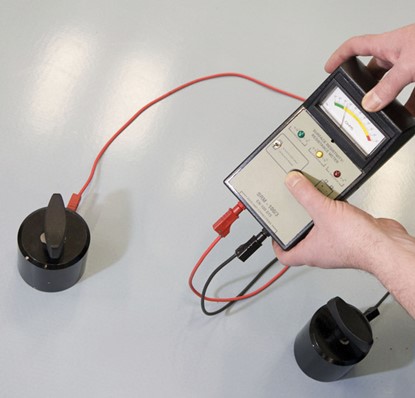
After installation, resistance testing should confirm that the system performs within the required range.
Without these steps, the floor may look correct but fail to function properly.
And in static control, appearance means nothing. Performance means everything.
So, Does Your Facility Need ESD Flooring?
Ask yourself a few practical questions:
- Do we manufacture or assemble sensitive electronics?
- Do we handle flammable vapours or combustible dust?
- Have we experienced unexplained electronic failures?
- Are we required to meet static control compliance standards?
If the answer to any of these is yes, it’s worth evaluating your flooring system.
You don’t have to assume you need it.
But you should measure and verify.
A professional site assessment can test surface resistance levels and determine whether your current flooring provides reliable static control.
Final Thought
Electrostatic discharge is invisible, but it is not insignificant.
In the right environment, it can quietly undermine product quality, operational safety, and regulatory compliance.
ESD flooring isn’t about adding a feature.
It’s about removing uncertainty.
If your operations depend on precision, stability, and controlled environments, managing static electricity at the ground level — literally — is one of the smartest long-term decisions you can make.