Industrial manufacturing floors rarely wear evenly across the entire facility.
Wear usually develops where people, trolleys, pallet trucks and vehicles repeatedly follow the same routes. Production-line walkways become dull, pedestrian crossings lose surface texture, line markings fade, and the busiest areas begin to show deterioration while less-used parts of the facility remain relatively intact.
The problem is not always that the flooring material was poor quality. In many cases, the floor was specified for “manufacturing use” as a single category, without accounting for the different traffic patterns, mechanical loads, environmental conditions and safety requirements within the facility.
For high-traffic manufacturing areas, flooring should be specified according to traffic type, traffic density, mechanical demands, environmental exposure, substrate condition and required performance.
Depending on the application, the appropriate solution may range from industrial epoxy flooring for general production areas to heavy-duty epoxy, aggregate-filled systems, polyurethane flooring, resin screeds or ESD flooring for more demanding zones.
The goal is not to install the most expensive flooring everywhere.
The goal is to install the right flooring system in the right zone.
What Is the Best Flooring for High-Traffic Manufacturing Areas?
There is no single flooring system that is best for every high-traffic manufacturing facility.
The appropriate system depends on the combination of:
- Pedestrian traffic
- Trolley and cart movement
- Pallet trucks and forklifts
- Wheel loading and turning
- Abrasion and impact
- Chemical exposure
- Moisture and washdown
- Cleaning methods
- Slip-resistance requirements
- Static-control requirements
- Substrate condition
For many manufacturing environments, industrial epoxy flooring is a practical option because properly specified epoxy systems can provide a durable, seamless and easy-to-maintain surface. However, demanding environments may require a higher-performance system or a different resin chemistry.
For example, aggregate-broadcast systems can provide additional texture where slip resistance and abrasion are important, while polyurethane systems may be more appropriate where thermal shock, chemical exposure or demanding cleaning conditions are significant factors.
The most reliable specification process is:
Assess the traffic → divide the facility into zones → identify mechanical and environmental stresses → select the resin system → determine build and finish → verify performance requirements → establish maintenance requirements.
This approach is more reliable than simply specifying one “heavy-duty” coating for the entire factory.
Table of Contents
- What Counts as High Traffic in a Manufacturing Facility?
- Why Traffic Mapping Should Come Before Flooring Selection
- How Different Traffic Types Affect Industrial Flooring
- High-Traffic Zones and Suitable Flooring Approaches
- How to Choose the Right Industrial Flooring System
- A Practical Traffic-to-Flooring Selection Framework
- Why High-Traffic Manufacturing Floors Wear Prematurely
- Slip Resistance in High-Traffic Manufacturing Areas
- Line Marking as Part of the Flooring Specification
- Standards and Technical Testing
- Maintenance and Recoating
- High-Traffic Flooring by Manufacturing Industry
- Real-World Manufacturing Flooring Example
- High-Traffic Manufacturing Flooring in Chennai and South India
- Benefits of Zone-Based Flooring Specification
- Common Mistakes
- How to Plan a High-Traffic Manufacturing Flooring Project
- Frequently Asked Questions
- Final Takeaway
What Counts as High Traffic in a Manufacturing Facility?
High traffic does not necessarily mean forklifts or heavy machinery.
A manufacturing area can experience significant flooring wear simply because hundreds of workers repeatedly walk along the same routes every shift. Adding hand trolleys, carts, pallet trucks or vehicles increases the mechanical demand further.
Typical high-traffic areas include:
- Main production walkways
- Assembly-line paths
- Pedestrian crossings
- Forklift and pedestrian intersections
- Routes between production and warehouse areas
- Shipping and dispatch approaches
- Breakroom and canteen approaches
- Locker-room and washroom approaches
- Shift-change circulation routes
- Frequently accessed inspection and maintenance areas
The important distinction is between traffic volume and concentrated mechanical loading.
Pedestrian traffic primarily produces cumulative abrasion and surface wear. Pallet trucks and forklifts introduce additional wheel loading, turning forces, braking forces, impact and localized mechanical stress.
A manufacturing facility may therefore need to evaluate several traffic types simultaneously where they overlap.
Why Traffic Mapping Should Come Before Flooring Selection
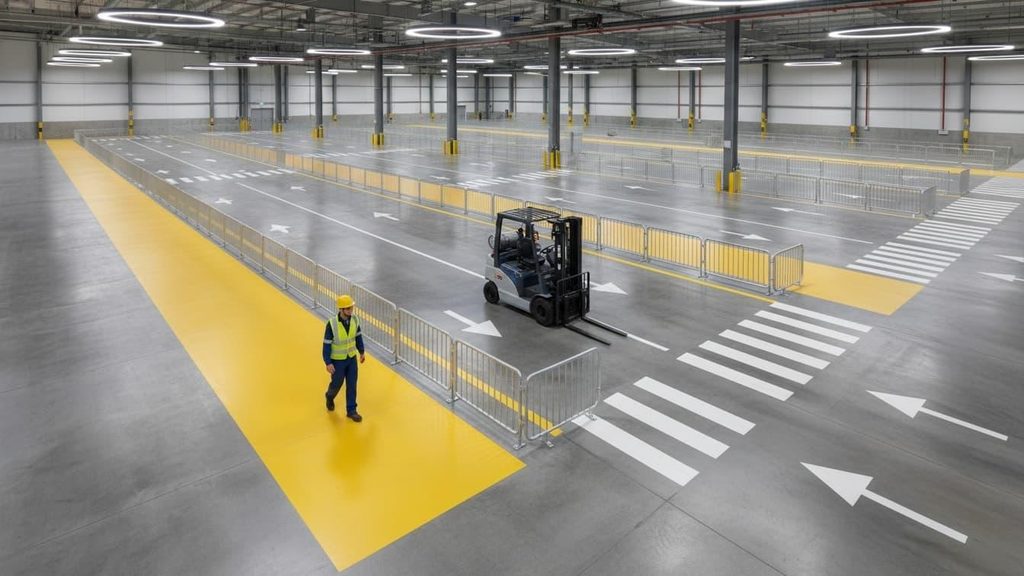
A manufacturing floor should not automatically receive the same flooring specification from wall to wall.
Consider a facility with 10,000 m² of production space. Although the entire area may be classified as manufacturing space, actual usage could be very different:
- Some areas may experience continuous pedestrian circulation.
- Others may carry trolley or pallet-truck traffic.
- Specific intersections may experience frequent forklift crossings.
- Production areas may experience moderate but distributed movement.
- Storage or support areas may have relatively low traffic.
Applying one identical specification everywhere can result in over-specification in low-use areas and under-specification in high-wear zones.
A Better Approach
Conduct a traffic assessment during normal operating conditions and identify:
- Where employees actually walk.
- Where trolleys and carts travel.
- Where pallet trucks and forklifts operate.
- Where pedestrians and vehicles intersect.
- Where shift changes create exceptionally high footfall.
- Where spills, washdown or chemical exposure occur.
- Where static-control requirements apply.
- Where impact or concentrated loading occurs.
This creates a traffic and risk map that can be used to develop a zone-based flooring specification.
A site walk during an operating shift can be particularly useful because actual movement patterns often differ from what a floor plan suggests.
How Different Traffic Types Affect Industrial Flooring
Pedestrian Traffic
High-volume pedestrian movement creates cumulative abrasion, particularly along repetitive routes.
Typical locations include assembly lines, production corridors, locker-room approaches and shift-change crossings.
Important considerations include:
- Abrasion resistance
- Surface durability
- Slip resistance
- Ease of cleaning
- Appearance retention
- Compatibility with line markings
A pedestrian-heavy area does not automatically require the same system as a forklift aisle. However, a coating designed for light-duty use may experience premature wear when subjected to continuous foot traffic.
Trolley and Cart Traffic
Trolleys and carts introduce greater mechanical wear than pedestrian traffic alone.
Wheel material is particularly important. Hard wheels can produce different stresses from softer rubber or polyurethane wheels.
Assessment should consider:
- Wheel material
- Wheel diameter
- Loaded trolley weight
- Frequency of movement
- Turning behaviour
- Repetitive routes
- Thresholds and joints
- Abrasive contamination
A route that appears to be primarily pedestrian may therefore require a more robust flooring system if trolleys use it continuously.
Pallet Trucks and Forklifts
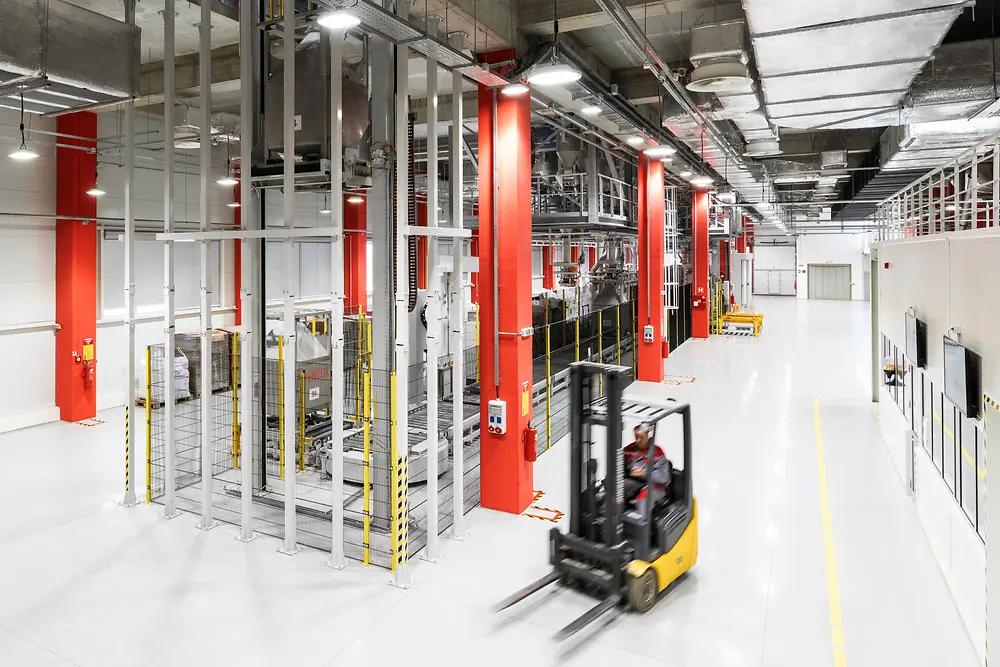
Forklift and pallet-truck areas require a broader mechanical assessment.
Important factors include:
- Wheel loads
- Wheel material
- Turning frequency
- Braking and acceleration
- Impact from dropped loads
- Abrasive contamination
- Joint and edge conditions
- Traffic frequency
These demands differ from ordinary pedestrian abrasion.
Where forklift traffic is substantial, the floor should be evaluated for mechanical loading and operational stresses, rather than simply specifying a thicker pedestrian coating.
For particularly demanding industrial areas, a dedicated heavy-duty epoxy flooring system may be considered as part of the overall specification.
Mixed Pedestrian-Vehicle Areas
Pedestrian-vehicle crossings are among the most demanding zones because two traffic patterns overlap.
They may experience:
- Heavy pedestrian movement
- Forklift or pallet-truck crossings
- Turning wheels
- Abrasion
- Impact
- Frequent cleaning
- Line-marking requirements
These areas may justify a more robust flooring specification combined with an appropriately designed slip-resistant surface.
High-Traffic Zones and Suitable Flooring Approaches
| Facility Zone | Typical Traffic | Flooring Approach |
| Main circulation walkway | Continuous pedestrian/trolley traffic | Industrial epoxy or equivalent system selected for sustained abrasion |
| Assembly-line path | Repetitive pedestrian movement | Durable, easy-to-clean system with appropriate slip resistance |
| Pedestrian-vehicle crossing | Foot + forklift/trolley traffic | Higher-performance system with suitable aggregate/texture and durable markings |
| Shift-change approach | Short periods of high footfall | Abrasion-resistant system with appropriate slip-resistant finish |
| Warehouse connection | Trolley/pallet-truck/forklift traffic | System selected for wheel loading, abrasion and impact |
| Wet or washdown zone | Foot traffic + moisture | Slip-resistant system compatible with cleaning and moisture conditions |
| ESD production zone | Pedestrian + static-control requirements | ESD-rated flooring selected for both electrical and mechanical requirements |
| General production floor | Moderate distributed traffic | Standard to mid-duty industrial flooring where conditions permit |
These are planning guidelines, not universal specifications. The final system should always be based on the actual site conditions.
How to Choose the Right Industrial Flooring System
The correct flooring system should be selected from the complete service environment, not traffic volume alone.
1. Industrial Epoxy Flooring
Epoxy systems can be suitable for many general manufacturing and production areas where traffic is predominantly pedestrian or involves light trolley movement and environmental demands are controlled.
Typical advantages include:
- Good chemical resistance, depending on formulation
- Strong adhesion when correctly specified and installed
- Easy cleaning
- Durable surface
- Wide colour selection
- Compatibility with line marking
However, “epoxy” describes a broad family of systems. Resin chemistry, coating build, aggregate, substrate preparation and installation quality all influence performance.
ChemCoats provides industrial epoxy flooring solutions in Chennai for manufacturing and commercial applications, with system selection based on the intended operating environment.
2. High-Build and Heavy-Duty Epoxy
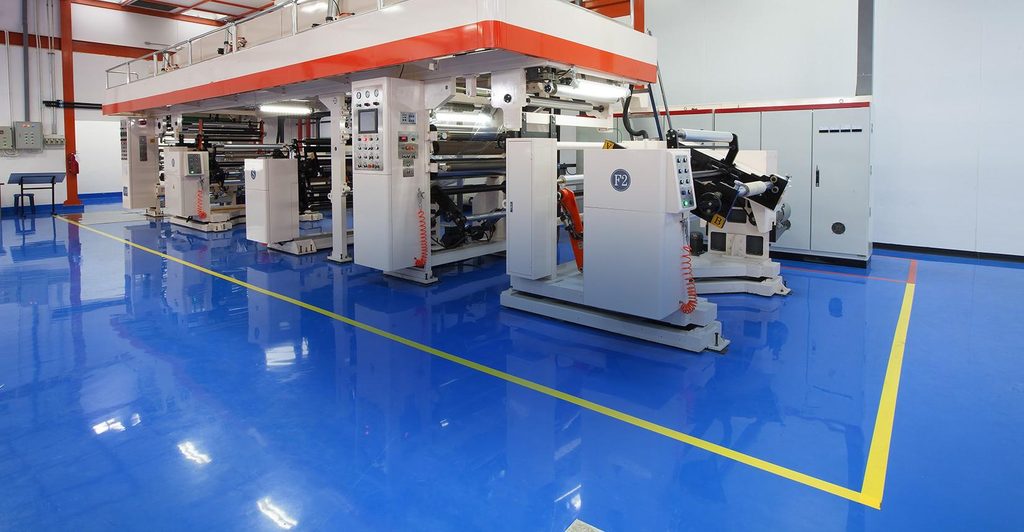
Higher-build or heavy-duty epoxy systems can be considered where the floor requires greater protection than a thin coating can provide.
Potential applications include:
- High pedestrian traffic
- Trolley routes
- Production corridors
- Moderate mechanical traffic
- Areas requiring greater abrasion resistance
- Areas exposed to industrial equipment
The required build should be determined by the complete system design and site conditions rather than applying a generic thickness to every project.
ChemCoats’ heavy-duty epoxy offering is positioned for demanding industrial environments involving high traffic, machinery and impact.
3. Quartz or Aggregate-Broadcast Systems
Quartz or other aggregate-broadcast systems can be useful where additional texture, wear resistance or slip resistance is required.
However, more texture is not automatically better.
The specification should balance:
Slip resistance + cleanability + abrasion + wheel traffic + contamination + maintenance
An excessively rough surface may improve traction while making cleaning more difficult or affecting wheeled traffic.
4. Flake Systems
Flake-broadcast systems can provide a decorative and functional finish in suitable manufacturing, circulation and support areas.
They may be appropriate where appearance and surface texture are important, but the system still needs to be matched to the actual mechanical and environmental conditions.
5. Polyurethane Flooring
Polyurethane-based systems can be appropriate for demanding industrial environments where properties beyond basic pedestrian abrasion resistance are required.
Depending on the formulation, important considerations may include:
- Chemical exposure
- Temperature variation
- Cleaning conditions
- Mechanical traffic
- Impact
- Thermal shock
Polyurethane should not automatically be considered superior to epoxy. The appropriate resin chemistry depends on the actual service environment.
6. ESD Flooring
Electronics and other static-sensitive manufacturing areas may require ESD flooring.
In these environments, flooring has two simultaneous objectives:
Mechanical durability + electrical performance
A mechanically durable floor that does not satisfy the required static-control characteristics is not an adequate ESD solution.
Likewise, an ESD system must be selected to withstand the traffic, cleaning and environmental conditions it will experience.
ChemCoats provides ESD flooring for Chennai industrial applications with properties intended for static-sensitive environments.
A Practical Traffic-to-Flooring Selection Framework
A simple decision process can help during the early specification stage.
Predominantly Pedestrian Traffic
Focus on:
- Abrasion resistance
- Slip resistance
- Cleanability
- Appearance retention
Pedestrian + Trolley Traffic
Add consideration of:
- Wheel hardness
- Loaded trolley weight
- Repetitive routes
- Turning behaviour
- Surface durability
Pedestrian + Pallet Truck/Forklift Traffic
Evaluate:
- Wheel loads
- Turning forces
- Impact
- Abrasion
- Joint condition
- Mechanical durability
Wet or Washdown Environment
Prioritize:
- Slip resistance
- Drainage
- Cleaning regime
- Moisture compatibility
- Chemical exposure
- Surface texture
Static-Sensitive Production
Add:
- Electrical resistance requirements
- Grounding system
- ESD testing requirements
- Cleaning and maintenance compatibility
Chemical Exposure
Evaluate:
- Chemical type
- Concentration
- Temperature
- Exposure frequency
- Dwell time
- Cleaning chemicals
The result should be a performance-based flooring specification, rather than simply selecting a product by name.
Why High-Traffic Manufacturing Floors Wear Prematurely
Traffic is only one part of the equation.
A floor may deteriorate early because the system was incorrectly selected, poorly installed or exposed to conditions that were not considered during specification.
1. Insufficient Substrate Preparation
Coatings depend heavily on substrate condition.
Contamination, laitance, weak concrete, moisture problems and inadequate surface preparation can compromise adhesion and long-term performance.
2. Incorrect Coating Build
A system designed for light use may not provide adequate protection under sustained mechanical traffic.
3. Wrong Resin System
A floor exposed to chemicals, washdown, temperature changes or heavy mechanical traffic may require different resin chemistry from a relatively dry pedestrian production area.
4. Incorrect Aggregate Selection
Aggregate size, distribution and surface texture influence both slip resistance and cleanability.
5. Abrasive Contamination
Dust, metal particles, sand and other debris can act as abrasives under wheels and footwear.
6. Forklift Turning
Repeated turning can produce different stresses from straight-line travel, particularly at intersections and tight operating areas.
7. Chemical and Cleaning Exposure
The floor must be compatible with the substances and cleaning methods used in the facility.
8. Poor Maintenance Planning
Even a well-specified floor requires inspection and maintenance. Waiting until severe deterioration occurs can increase the eventual repair requirement.
Slip Resistance: Design It for the Working Environment
Slip resistance should be treated as a performance requirement, not simply a visual characteristic.
A smooth resin floor may be appropriate in some dry environments, while a textured or aggregate-filled finish may be more appropriate where moisture, oils or other contaminants are present.
The correct surface profile needs to balance:
Traction + cleanability + traffic + contamination + maintenance
The selected slip-resistance test method should be appropriate to the facility and intended performance claim. Test results from different methods should not automatically be treated as directly interchangeable.
The key is to specify and verify slip performance for the actual operating environment, rather than selecting a finish based solely on appearance.
Line Marking Should Be Part of the Flooring Specification
Line markings are often treated as a final cosmetic step. In a busy manufacturing facility, that can be a mistake.
Floor markings may define:
- Pedestrian walkways
- Forklift routes
- Safety zones
- Equipment areas
- Storage locations
- Emergency routes
- Restricted areas
If the marking material has significantly different performance characteristics from the surrounding coating, it may wear or lose adhesion before the floor itself requires maintenance.
Line marking should therefore be selected alongside the main flooring system and checked for:
- Compatibility
- Adhesion
- Abrasion resistance
- Cleaning resistance
- Colour retention
- Reapplication requirements
Standards and Technical Testing
Technical specifications should reference standards and test methods relevant to the actual performance requirement.
For example, abrasion resistance, coating adhesion and slip performance can be evaluated using recognized test methods appropriate to the coating and application.
The specific standard should be selected based on:
- The flooring system
- Substrate
- Intended performance claim
- Operating environment
- Project specification
- Applicable regional requirements
Standards should therefore be confirmed during the project specification stage rather than added as generic references after the flooring system has already been selected.
Maintenance Strategy for High-Traffic Manufacturing Floors
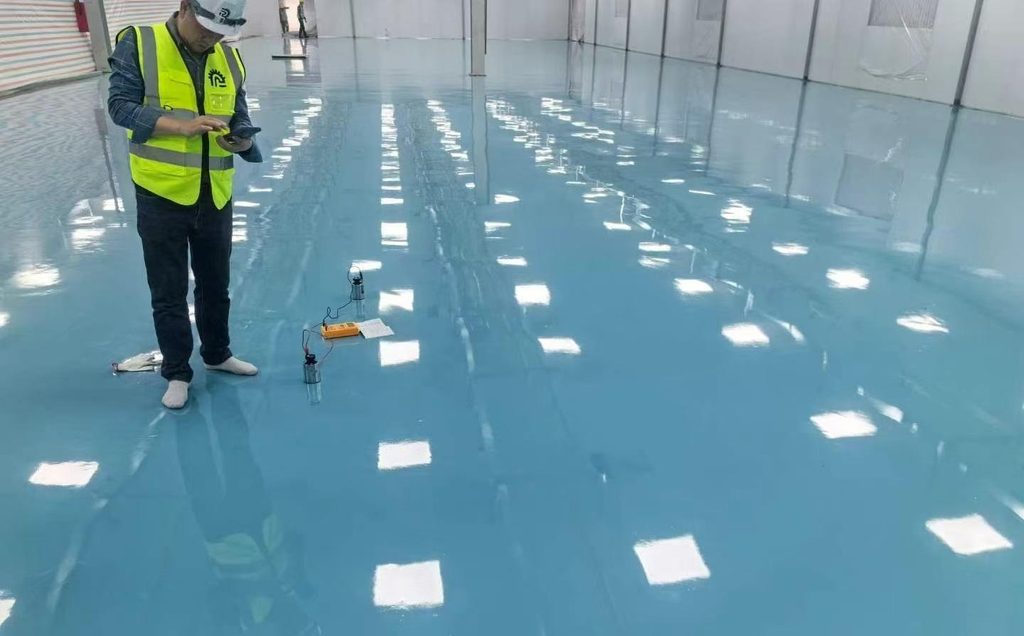
High-traffic areas will generally experience wear faster than lightly used areas.
That does not necessarily mean the entire floor needs to be recoated at the same time.
A better maintenance strategy establishes:
Routine Inspection
Monitor:
- Dull or polished areas
- Loss of surface texture
- Exposed aggregate
- Peeling
- Cracking
- Impact damage
- Line-marking deterioration
- Changes in slip performance
Zone-Based Maintenance
Prioritize areas with the greatest traffic instead of treating the entire facility as one maintenance category.
Planned Partial Recoating
Where practical, schedule maintenance for the busiest routes before severe deterioration occurs.
Line-Marking Renewal
Refresh worn markings at the same time as localized coating maintenance where appropriate.
Root-Cause Investigation
If a coating repeatedly fails in the same location, investigate traffic behaviour, substrate condition, contamination and system selection rather than simply applying another coat.
How Often Should High-Traffic Industrial Flooring Be Recoated?
There is no universal recoating interval for every manufacturing floor.
Service life depends on:
- Traffic volume
- Traffic type
- Flooring system
- Coating build
- Substrate condition
- Cleaning methods
- Chemical exposure
- Impact
- Wheel type
- Installation quality
- Maintenance practices
Instead of promising a fixed number of years, facility managers should establish condition-based inspections and use the observed wear rate to plan maintenance.
A high-traffic crossing may require attention significantly earlier than a lightly used production area within the same facility.
High-Traffic Flooring by Manufacturing Industry
Automotive Manufacturing
Automotive facilities often combine continuous pedestrian movement with trolley, pallet-truck and forklift traffic.
Particular attention should be given to:
- Assembly-line paths
- Vehicle and pedestrian crossings
- Logistics routes
- Production-to-warehouse connections
- Oil or chemical exposure
- Line markings
Zone-based specification is often more appropriate than applying one identical system throughout the facility.
Electronics Manufacturing
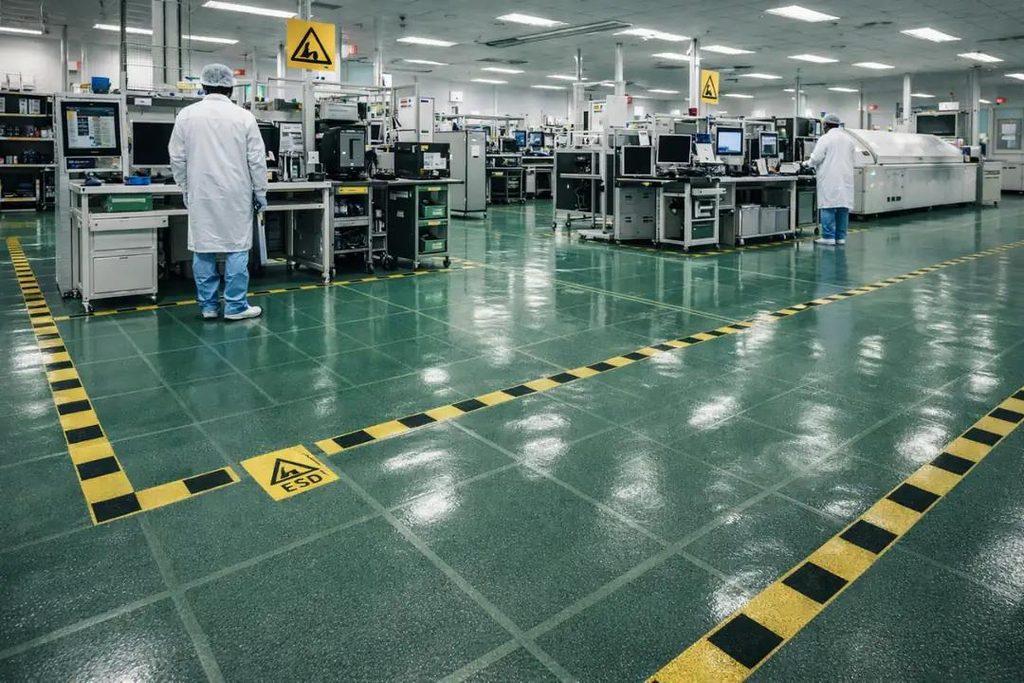
Electronics facilities may combine high pedestrian traffic with ESD requirements.
Flooring selection should consider:
- Static-control requirements
- Foot traffic
- Trolley movement
- Cleaning
- Assembly processes
- Electrical performance over the service life
ESD performance and mechanical durability should be specified together.
ChemCoats also lists ESD and anti-static flooring among its industrial flooring solutions for electronics and other static-sensitive environments.
FMCG and Packaging
FMCG and packaging environments may experience continuous traffic, frequent cleaning and potentially wet or spill-prone conditions.
Key considerations include:
- Slip resistance
- Cleanability
- Cleaning chemicals
- Moisture
- Drainage
- Traffic density
- Hygiene requirements
The flooring system must be selected for the complete operating environment rather than traffic alone.
Textile and Apparel Manufacturing
Textile facilities can have large areas of continuous pedestrian movement along production lines.
Typical priorities include:
- Abrasion resistance
- Easy cleaning
- Slip resistance
- Appearance
- Consistent performance across large floor areas
Because traffic can be relatively distributed, a broader heavy-duty specification may sometimes make sense instead of highly localized zoning.
Real-World Manufacturing Flooring Example: Aadhi Tape Solutions
A practical example of how operating conditions influence industrial flooring selection is ChemCoats’ project for Aadhi Tape Solutions.
According to the published project description, the tape-cutting facility faced dust accumulation on the floor alongside high traffic and heavy machinery. Dust contamination was affecting the production environment and the quality of the adhesive tape operation.
The flooring requirement therefore went beyond simple pedestrian wear. The facility needed a surface that could help control dust while withstanding high traffic and demanding industrial conditions.
ChemCoats implemented an optimized epoxy coating intended to provide a durable, abrasion-resistant and easy-to-clean surface suitable for the tape-cutting environment.
Project Takeaway
The important lesson is that high-traffic flooring is not simply about selecting the thickest coating.
Traffic needs to be evaluated together with:
- Contamination
- Machinery
- Cleaning
- Abrasion
- Production requirements
- Substrate condition
This is why a site-specific flooring assessment is more useful than choosing a generic “heavy-duty factory floor” specification.
View the Aadhi Tape Solutions industrial flooring project
High-Traffic Manufacturing Flooring in Chennai and South India
Manufacturing facilities across Chennai and South India operate across a wide range of industries, including automotive, electronics, pharmaceuticals, engineering, FMCG and logistics.
These facilities can have significantly different flooring requirements depending on:
- Production processes
- Pedestrian traffic
- Material movement
- Forklift activity
- Cleaning practices
- Chemical exposure
- Moisture
- Static-control requirements
- Production schedules
For facilities in Chennai and surrounding industrial regions, flooring selection should therefore consider the site’s actual traffic pattern and operating environment rather than relying on a generic “factory flooring” specification.
ChemCoats states that it has been providing industrial flooring solutions in Chennai and the wider South India region, with systems including epoxy, PU, ESD, anti-static and heavy-duty flooring.
Explore ChemCoats industrial flooring solutions in Chennai
Benefits of Zone-Based Industrial Flooring
More Even Wear
The busiest areas receive the performance they require instead of being treated as ordinary production space.
Better Safety Management
Slip resistance, line markings and surface condition can be monitored according to actual usage.
More Predictable Maintenance
Maintenance teams can identify high-wear zones before they require major repairs.
Better Use of Flooring Budget
Higher-performance systems can be concentrated in demanding areas while suitable lower-cost systems are used where conditions allow.
Fewer Production Disruptions
Localized maintenance can be planned around specific zones instead of waiting until widespread deterioration forces a larger shutdown.
Common Mistakes in High-Traffic Manufacturing Flooring
Treating the Entire Facility as One Traffic Category
Problem: High-use areas receive the same specification as lightly used areas.
Better approach: Map actual traffic density and identify high-wear routes.
Focusing Only on Forklifts
Problem: Pedestrian-heavy areas are underestimated.
Better approach: Assess footfall, trolley movement and vehicle traffic together.
Assuming Thicker Always Means Better
Problem: Thickness alone does not solve chemical, moisture, impact, slip or substrate-related problems.
Better approach: Select the complete flooring system according to service conditions.
Selecting Slip Resistance by Appearance
Problem: A visibly textured floor is assumed to provide adequate performance.
Better approach: Specify and verify slip performance using an appropriate test method.
Treating Line Marking as an Afterthought
Problem: Markings wear significantly earlier than the surrounding floor.
Better approach: Specify compatible marking materials as part of the flooring system.
Waiting for Visible Failure Before Maintenance
Problem: Minor wear becomes extensive deterioration.
Better approach: Inspect high-traffic zones regularly and plan localized maintenance.
Using Generic Product Recommendations
Problem: A system suitable for one manufacturing environment is assumed to work everywhere.
Better approach: Evaluate the actual traffic, substrate, chemicals, moisture, cleaning and operational conditions before final specification.
How to Plan a High-Traffic Manufacturing Flooring Project
A practical project workflow is:
1. Survey the Facility
Review the existing substrate, joints, cracks, moisture conditions and previous coating performance.
2. Map Traffic
Record pedestrian, trolley, pallet-truck and forklift movement during normal operations.
3. Identify High-Risk Zones
Mark crossings, wet areas, chemical exposure, high-footfall areas and static-sensitive production zones.
4. Define Performance Requirements
Establish abrasion, mechanical, slip, chemical, electrical and cleaning requirements.
5. Select the Flooring System
Choose the resin chemistry, build, aggregate and finish according to the requirements.
6. Specify Line Markings
Integrate safety markings into the overall coating specification.
7. Establish Installation Controls
Define substrate preparation, application conditions, curing and quality checks.
8. Plan Maintenance
Set inspection points and condition-based maintenance requirements for the highest-traffic zones.
This approach turns flooring from a generic construction finish into a facility performance system.
Expert Insight
High-traffic flooring should not be selected solely by coating thickness or resin type.
A proper flooring assessment should consider pedestrian movement, trolley and forklift traffic, wheel type, turning behaviour, contamination, cleaning, moisture, chemicals and substrate condition.
Mapping these factors zone by zone helps prevent unnecessary over-specification in low-use areas while protecting the routes that experience the greatest wear.
Frequently Asked Questions
What Is the Best Flooring for a Busy Factory?
There is no single best flooring system for every factory. The appropriate solution depends on traffic type, traffic density, substrate, chemicals, moisture, cleaning, slip resistance, impact and other operating conditions.
Epoxy is widely used in manufacturing, but higher-performance epoxy, aggregate systems, polyurethane, resin screeds or specialized ESD systems may be more appropriate for particular zones.
Is Epoxy Flooring Suitable for High-Traffic Manufacturing Areas?
Yes. Epoxy can be suitable for many high-traffic manufacturing environments when the resin system, build, aggregate, substrate preparation and finish are correctly selected.
Heavy forklift, impact, thermal or chemical environments may require a different or more specialized system.
Is High-Traffic Flooring the Same as Heavy-Duty Forklift Flooring?
No.
High pedestrian traffic mainly creates cumulative abrasion and surface wear. Forklift and pallet-truck traffic introduces wheel loading, turning forces, impact and other mechanical stresses.
Where both occur, both requirements should be included in the flooring specification.
Does Thicker Epoxy Always Last Longer?
Not necessarily.
Performance depends on the complete system and installation quality. Substrate preparation, resin chemistry, aggregate selection, curing, traffic conditions and environmental exposure can all affect service life.
What Flooring Finish Is Best for Slip Resistance?
The appropriate finish depends on contamination, moisture, cleaning methods, footwear, traffic and operating conditions.
Aggregate or textured finishes can improve traction, but excessive texture may make cleaning and wheeled traffic more difficult.
Slip resistance should therefore be specified according to the actual environment and verified using an appropriate test method.
How Does Foot Traffic Affect Industrial Flooring?
High footfall creates cumulative surface abrasion, particularly along repetitive routes such as production lines, corridors and shift-change approaches.
Even without forklifts, heavily trafficked pedestrian routes can wear faster than surrounding areas.
Should Line Marking Be Included in the Flooring Specification?
Yes.
Line marking should be considered part of the complete flooring system so that compatibility, adhesion, durability, cleaning resistance and maintenance requirements are addressed together.
How Often Should High-Traffic Factory Flooring Be Recoated?
There is no universal interval.
Recoating depends on traffic, flooring system, substrate, cleaning, chemical exposure and maintenance.
Condition-based inspection of high-traffic zones provides a better basis for planning than relying on a fixed calendar interval.
Can One Flooring System Be Used Throughout a Manufacturing Facility?
It can be appropriate for smaller or relatively uniform facilities.
However, where traffic, chemical exposure, moisture, ESD requirements or mechanical demands vary substantially, zone-based specification is often more effective.
About ChemCoats
ChemCoats provides industrial flooring solutions for manufacturing, electronics, pharmaceutical, warehousing and other industrial environments in Chennai and the wider South India region.
Its flooring portfolio includes epoxy, polyurethane, heavy-duty epoxy, ESD and anti-static flooring systems, among other specialized solutions. ChemCoats states that it has more than 17 years of industry experience and more than 100 completed flooring projects.
For high-traffic manufacturing projects, the key starting point is not simply choosing a product. The facility should first be assessed for traffic patterns, substrate condition, environmental exposure, mechanical requirements, safety requirements and production constraints.
Explore ChemCoats Industrial Flooring Solutions
Final Takeaway
High-traffic manufacturing flooring should not be specified simply because an area is classified as a “factory floor.”
The more important question is:
What does each part of the floor actually experience every day?
Pedestrian traffic, trolley movement, pallet trucks, forklifts, shift-change footfall, moisture, chemicals, cleaning and static-control requirements can create very different demands within the same facility.
The most effective approach is to:
- Map actual traffic across the facility.
- Identify high-density and mixed-traffic zones.
- Separate pedestrian abrasion from vehicle and mechanical loading.
- Evaluate substrate and environmental conditions.
- Select the resin system according to the complete service environment.
- Match coating build and surface texture to the required performance.
- Specify slip resistance and line marking as part of the overall system.
- Use appropriate testing and standards where required.
- Establish a planned inspection and maintenance cycle for high-wear zones.
The objective is not simply to install the thickest or most expensive flooring everywhere.
It is to create a performance-based flooring specification that delivers durability, safety and predictable maintenance where the facility needs them most.
For manufacturing facilities planning a new floor or refurbishing an existing one, a site-specific assessment of traffic patterns, substrate condition and operating environment should be completed before the final flooring system is selected.
Planning a high-traffic manufacturing flooring project in Chennai or South India?