Heavy machinery areas place very different demands on industrial floors than ordinary factory walkways or warehouse aisles. The challenge is not simply the overall weight of the equipment. Machine feet and anchor points can create concentrated loads, operating equipment can transmit vibration into the slab, and machining or manufacturing processes may expose the floor to oils, coolants, hydraulic fluids, chemicals and heat.
For precision equipment, floor levelness and flatness can also become important to equipment installation, alignment and operation.
A flooring system that performs well under pedestrian or light trolley traffic may therefore be unsuitable around a CNC machine, stamping press, injection molding machine or industrial mixer.
The right approach is to treat heavy machinery zones as a separate flooring specification area, assess the actual operating conditions, and select the resin system, thickness, surface finish and substrate preparation accordingly.
Important: The flooring system protects and finishes the floor surface, but it does not replace structural engineering. Equipment foundation capacity, slab design, anchoring and significant vibration issues should be assessed by the appropriate qualified professionals.
Direct Answer: What Is the Best Flooring for Heavy Machinery Areas?
There is no single flooring system that is best for every heavy machinery application.
Heavy-duty epoxy flooring is a common option for industrial machinery areas because of its durability, abrasion resistance and chemical-resistance characteristics. Depending on the environment, polyurethane, chemical-resistant resin systems, self-leveling epoxy or other specialized systems may be more appropriate.
The selection should be based on:
- Concentrated machine loads
- Foundation and anchor-point conditions
- Vibration
- Oils, coolants and chemicals
- Heat exposure
- Required floor levelness
- Cleaning methods
- Traffic around the machinery
- Substrate condition
- Maintenance requirements
The key principle is simple:
Specify the machinery zone according to what the equipment actually experiences—not simply according to the fact that it is located inside a factory.
Quick Answer: Heavy Machinery Flooring at a Glance
| Question | Answer |
| What makes machinery areas different? | Concentrated loads, vibration, fluids, heat and sometimes tighter levelness requirements |
| What flooring is commonly considered? | Heavy-duty epoxy, polyurethane or specialized resin systems depending on conditions |
| What is the most important load consideration? | Point loading at machine feet, foundations and anchor locations |
| Is standard epoxy always suitable? | No. The resin, build and detailing must match the application |
| What about oil and coolant? | Check compatibility with the specific fluids used |
| Does vibration affect flooring? | Yes, particularly at joints, edges, foundations and weak substrate areas |
| Can flooring fix an uneven slab? | It can improve surface flatness, but it cannot replace proper substrate correction |
| Who should assess structural loads? | A qualified structural engineer where equipment loads or vibration are significant |
| Best practice | Treat heavy machinery zones separately from general factory flooring |
Table of Contents
- What Makes Heavy Machinery Areas Different?
- What Flooring Is Best for Heavy Machinery?
- Key Factors When Choosing Machinery-Area Flooring
- Flooring Options for Heavy Machinery
- Flooring Recommendations by Machinery Type
- Heavy Machinery Flooring by Industry
- When Standard Epoxy May Not Be Enough
- How to Specify Flooring Around Heavy Machinery
- Cost Considerations
- Common Mistakes
- Representative Application Example
- Industrial Flooring Solutions from Chemcoats
- Standards and Technical Considerations
- Frequently Asked Questions
- Conclusion
What Makes Heavy Machinery Areas Different?
Heavy machinery can impose several stresses on the floor simultaneously.
Consider a CNC machining center. Its weight may be concentrated through specific machine feet or foundation points. During operation, vibration can be transmitted through the equipment into the supporting structure. Cutting fluids and coolants may reach the surrounding floor, while cleaning may involve degreasers or other chemicals.
A stamping press presents a different combination of stresses. The equipment may generate significant vibration and dynamic forces, while concentrated loads occur at foundation or anchoring locations.
An injection molding machine may introduce another combination involving machine weight, oils, heat and cleaning chemicals.
This is why a machinery area should not automatically receive the same flooring specification as the surrounding production floor.
The four major considerations are:
Mechanical loading
Concentrated loads can occur at machine feet, foundations and anchors.
Vibration
Operating equipment can transmit repeated movement and dynamic forces into the slab and flooring system.
Chemical and fluid exposure
Oils, coolants, hydraulic fluids and cleaning chemicals can affect coatings differently.
Precision requirements
Certain machinery may require specific floor flatness or levelness tolerances for installation and alignment.
Why Machinery-Area Flooring Selection Matters
A common mistake is to specify the general factory floor first and simply extend the same system underneath or around heavy machinery.
That can create problems when the machinery area has substantially different requirements.
Potential problem
The general flooring specification may not account for:
- Concentrated point loads
- Vibration
- Machine anchoring
- Oil and coolant exposure
- Heat
- Precision levelness
- Specialized cleaning
Potential consequence
The result may be localized:
- Cracking
- Delamination
- Staining
- Softening
- Surface wear
- Loss of adhesion
- Coating fatigue
- Difficult maintenance around installed machinery
Repairing a damaged floor in an open warehouse aisle is one thing. Repairing flooring underneath or immediately around a permanently installed machine can be much more disruptive.
Better approach
Treat machinery zones as distinct specification zones within the overall industrial flooring design.
Key Factors When Choosing Flooring for Heavy Machinery Areas
1. Point Load at Machine Foundations
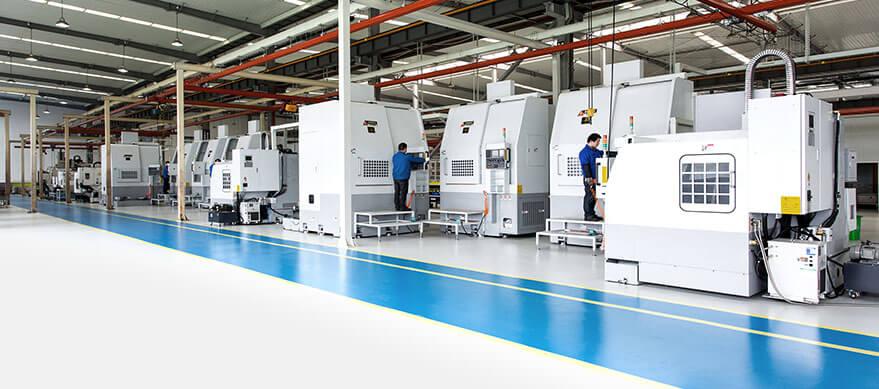
Machine weight is rarely distributed perfectly across the entire equipment footprint.
Instead, significant loads can be transferred through:
- Machine feet
- Foundation pads
- Anchor bolts
- Base plates
- Support frames
- Localized foundation structures
This creates a different loading condition from ordinary pedestrian traffic.
A coating that performs well across a general production floor may still be unsuitable if the substrate or flooring detail around concentrated load points is inadequate.
What to do
Obtain machine foundation and loading information from the equipment manufacturer wherever available.
Where equipment is particularly heavy or generates significant dynamic forces, the structural capacity of the slab and foundation should be assessed by a qualified structural engineer.
Do not estimate foundation loads simply from the machine’s total weight.
2. Vibration
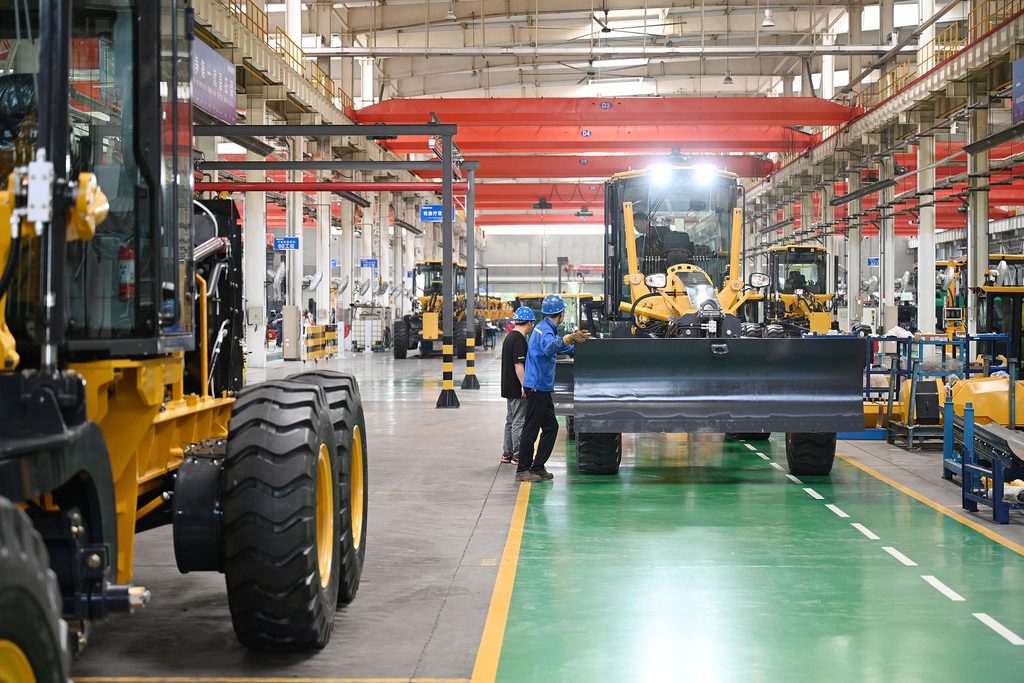
Vibration is an important consideration for presses, stamping equipment and other machinery that produces repeated dynamic movement.
The vibration itself is not necessarily a reason to reject epoxy flooring. Instead, the complete floor and foundation assembly needs to be considered.
Particular attention should be paid to:
- Construction joints
- Cracks
- Edges
- Weak or poorly bonded areas
- Machine foundations
- Anchor locations
- Areas where the substrate is already deteriorated
Where significant vibration isolation is required, that is primarily a structural and mechanical engineering consideration rather than something a surface coating can solve by itself.
Practical approach
Identify vibration-generating machinery during the design or site-assessment stage and coordinate the flooring specification with the structural and mechanical requirements.
3. Oil, Coolant and Fluid Exposure
Machining and manufacturing operations can expose floors to:
- Cutting oils
- Water-soluble coolants
- Hydraulic fluids
- Lubricants
- Solvents
- Cleaning chemicals
- Process chemicals
A general statement such as “chemical-resistant epoxy” is not enough.
Chemical resistance is dependent on the specific resin system, chemical, concentration, temperature and duration of exposure.
Best practice
Document the actual fluids used around each machine and compare them against the flooring manufacturer’s chemical-resistance information.
This is particularly important when exposure is frequent or when spills may remain on the surface for extended periods.
4. Levelness and Flatness
Precision machinery can have specific installation requirements for the floor beneath it.
Examples include:
- CNC machining centers
- Precision inspection equipment
- Certain assembly equipment
- Metrology equipment
- Specialized production machinery
A self-leveling resin system can produce a smoother and more uniform surface, but it should not be treated as a substitute for correcting a severely irregular substrate.
The equipment manufacturer’s installation requirements should be reviewed before the flooring system is finalized.
Important distinction
Floor coating flatness ≠ structural slab correction.
If the underlying concrete has significant irregularities, those should be assessed and corrected using an appropriate substrate-preparation or leveling approach.
Chemcoats provides self-leveling epoxy flooring solutions for applications where a smooth and level resin surface is required.
5. Heat Exposure
Some machinery areas experience localized heat.
This can occur around:
- Molding equipment
- Metal-forming equipment
- Welding-adjacent processes
- Thermal processing equipment
- Heated machinery
- Hot process materials
Standard epoxy systems have application-specific temperature limitations. Repeated exposure beyond the system’s capability can contribute to discoloration, softening or degradation.
Before selecting the system
Determine:
- Normal operating temperature
- Maximum surface temperature
- Frequency of exposure
- Duration of exposure
- Whether heat is continuous or intermittent
The flooring system should then be selected according to the manufacturer’s technical data.
6. Cleaning and Housekeeping
Machinery areas often require more intensive cleaning than general factory floors.
Metal shavings, oil, coolant and process residue may need to be removed regularly.
The cleaning process can include:
- Degreasers
- Detergents
- Pressure washing
- Solvent-based cleaners
- Mechanical scrubbing
The flooring system should therefore be compatible with the actual cleaning regime.
A coating that resists the production fluid but degrades under repeated cleaning chemicals may still be unsuitable for the application.
What Flooring Is Best for Heavy Machinery?
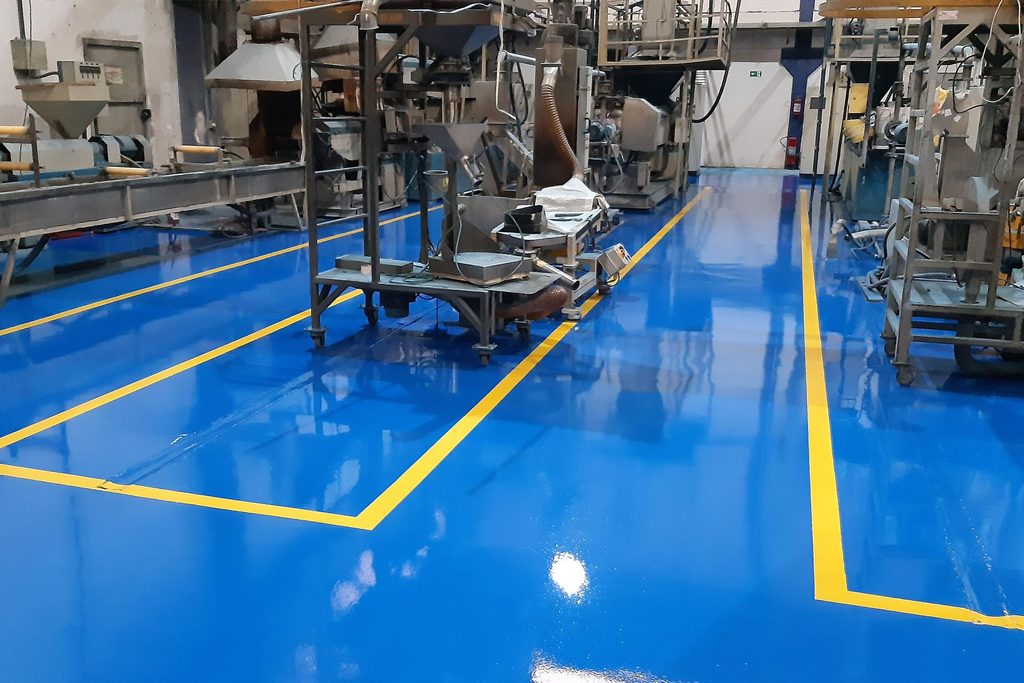
The answer depends on the machinery and operating environment.
Heavy-Duty Epoxy Flooring
Heavy-duty epoxy can be considered for machinery areas where durability, abrasion resistance and chemical resistance are important.
It can be particularly useful where the floor experiences:
- Heavy traffic around equipment
- Trolleys and pallet movement
- Mechanical abrasion
- Oil exposure
- General industrial use
However, the system should be specified according to the actual loads and environmental conditions rather than simply choosing the thickest available epoxy.
Chemcoats offers heavy-duty epoxy flooring solutions for demanding industrial environments.
High-Build Epoxy
A higher-build system may be appropriate where greater surface protection is required than a thin coating can provide.
Potential applications include:
- Machinery surroundings
- Production areas
- High-traffic routes
- Industrial workshops
- Equipment staging areas
The required thickness should be determined by the flooring system design and service conditions.
Polyurethane Flooring
Polyurethane systems can be considered where the operating environment requires properties that may be better suited to a PU system.
Depending on the formulation, considerations can include:
- Chemical exposure
- Mechanical traffic
- Temperature
- Cleaning
- Impact
- Thermal conditions
The choice between epoxy and polyurethane should therefore be based on the actual application rather than assuming one resin is universally superior.
Chemical-Resistant Resin Systems
Where machinery is exposed to aggressive chemicals, the flooring system should be selected based on the actual substances handled.
The assessment should consider:
- Chemical identity
- Concentration
- Temperature
- Exposure frequency
- Spill duration
- Cleaning chemicals
For particularly aggressive environments, specialized chemical-resistant flooring may be more appropriate than a standard industrial epoxy.
Self-Leveling Epoxy
Self-leveling systems can be useful where a smooth and uniform surface is required.
They may be considered for:
- Precision manufacturing areas
- Equipment installation zones
- Production floors
- Laboratories
- Clean manufacturing environments
However, the substrate must still be suitably prepared before application.
Flooring Recommendations by Machinery Type
| Machinery | Main Challenge | Flooring Considerations |
| CNC machining centers | Coolant, oil and precision installation | Chemical compatibility + levelness |
| Stamping presses | Vibration and concentrated loading | Heavy-duty system + foundation detailing |
| Injection molding machines | Heat and oil exposure | Thermal + chemical resistance |
| Industrial mixers/reactors | Chemical exposure | Chemical-specific resin selection |
| General assembly machinery | Moderate mechanical loading | Industrial epoxy based on actual conditions |
| Precision equipment | Flatness and levelness | Substrate preparation + suitable leveling system |
| Heavy process equipment | High load + possible vibration | Structural assessment + high-performance flooring |
These are starting points for specification, not universal product recommendations.
Heavy Machinery Flooring by Industry
Automotive Manufacturing
Automotive production environments can combine:
- Stamping presses
- Assembly equipment
- Material-handling vehicles
- Oils
- Lubricants
- Localized heat
- High pedestrian traffic
The flooring specification should therefore distinguish between general circulation areas and machinery foundations.
Metal Fabrication and Machining
Machining areas commonly experience:
- Cutting fluids
- Coolants
- Oils
- Metal particles
- Mechanical traffic
- Machine vibration
The floor should be selected for the actual combination of chemical and mechanical exposure.
Plastics and Rubber Manufacturing
Injection molding and extrusion areas may experience:
- Heat
- Oils
- Release agents
- Cleaning chemicals
- Heavy machinery loads
The system should be checked against the actual operating temperature and chemical exposure.
Chemical and Process Manufacturing
Mixers, reactors and processing equipment can expose flooring to aggressive chemicals.
In these areas, chemical resistance may be the governing factor rather than traffic alone.
The flooring system should be matched to the actual chemicals, concentrations and exposure conditions.
Precision Manufacturing and Tool Rooms
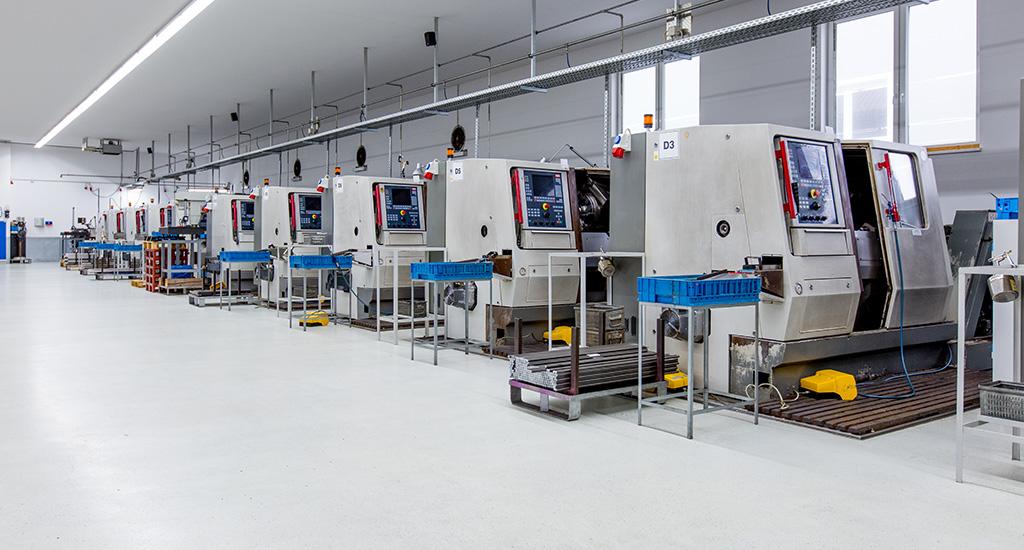
For precision manufacturing, floor flatness and levelness can become particularly important.
The flooring specification should therefore be coordinated with:
- Equipment installation drawings
- Manufacturer tolerances
- Substrate survey
- Leveling requirements
- Equipment anchoring
When Standard Epoxy May Not Be Enough
Standard industrial epoxy can be an excellent solution for many applications, but it should not automatically be specified for every machinery environment.
A different or more specialized approach may need to be considered where there is:
- Severe vibration
- Extreme temperature
- Aggressive chemical exposure
- Significant thermal shock
- Specialized ESD requirements
- Severe impact
- Unusual mechanical loading
- Persistent moisture
- Highly demanding cleaning
In these situations, the answer may involve a different resin chemistry, additional aggregate, greater build, specialized detailing, substrate repair or structural intervention.
The important point is to identify the actual failure mechanism before selecting the flooring system.
How to Specify Flooring Around Heavy Machinery
A practical specification process can follow these steps.
Step 1: Identify the machinery
Prepare a list of all fixed machinery and record:
- Equipment type
- Manufacturer
- Model
- Weight
- Foundation arrangement
- Anchor locations
- Operating conditions
Step 2: Obtain manufacturer information
Where available, obtain equipment installation drawings showing:
- Foundation requirements
- Anchor positions
- Load information
- Levelness tolerances
- Vibration characteristics
Step 3: Survey the substrate
Assess:
- Concrete condition
- Cracks
- Joints
- Surface contamination
- Existing coatings
- Moisture conditions
- Flatness and levelness
Step 4: Identify environmental exposure
Record:
- Oils
- Coolants
- Chemicals
- Heat
- Water
- Cleaning products
- Abrasive contamination
Step 5: Separate machinery zones
Do not automatically use one flooring specification across the entire facility.
Identify:
- Machinery foundations
- Production areas
- Walkways
- Material-handling routes
- Wet areas
- Chemical zones
- Maintenance areas
Step 6: Select the flooring system
Choose the resin chemistry, build, aggregate and finish according to the documented requirements.
Step 7: Coordinate structural requirements
Where equipment is heavy, vibrating or structurally demanding, coordinate with the appropriate structural or mechanical engineer.
Step 8: Define installation requirements
The specification should cover:
- Surface preparation
- Repair requirements
- Primer
- Resin layers
- Aggregate
- Thickness
- Curing
- Environmental conditions
- Quality control
Step 9: Establish maintenance requirements
Define how the floor will be:
- Cleaned
- Inspected
- Repaired
- Recoated
- Monitored around high-wear areas
Cost Considerations for Heavy Machinery Flooring
Machinery zones can cost more per square metre than general factory flooring because they may require:
- Higher-performance resin systems
- Additional surface preparation
- Specialized chemical resistance
- Leveling work
- More detailed foundation treatment
- Higher-performance topcoats
- Additional quality-control requirements
However, the machinery area is often only a relatively small portion of the overall facility.
This creates an opportunity for zone-based specification.
Instead of installing the most expensive flooring throughout the entire building, the higher-performance system can be concentrated where the operating conditions justify it.
The cheapest initial coating is not necessarily the lowest-cost solution over the life of the facility. Repairs around permanently installed machinery can be particularly disruptive.
Common Mistakes When Flooring Heavy Machinery Areas
Applying the General Factory Specification
Problem: The same flooring system is used everywhere.
Risk: Machinery zones may experience loads, vibration or chemicals that the general floor was not designed for.
Better approach: Specify machinery areas separately.
Ignoring Point Loads
Problem: Equipment weight is considered only as total machine weight.
Risk: Concentrated loads at feet and anchors are overlooked.
Better approach: Obtain foundation and anchor information from the equipment manufacturer.
Assuming “Oil Resistant” Means Resistant to Every Oil
Problem: A generic chemical-resistance claim is accepted without checking the actual fluid.
Risk: Staining, softening or degradation.
Better approach: Check the exact oil, coolant or chemical against technical data.
Ignoring Vibration
Problem: Flooring is selected based only on static loading.
Risk: Long-term fatigue or cracking around vulnerable areas.
Better approach: Identify vibration-generating equipment early and coordinate foundation requirements.
Using Flooring to Correct Major Substrate Problems
Problem: A thick or self-leveling coating is expected to correct severe concrete irregularities.
Risk: The underlying problem remains.
Better approach: Correct the substrate before applying the final flooring system.
Ignoring Heat
Problem: Standard flooring is installed next to hot equipment without confirming surface temperatures.
Risk: Softening, discoloration or premature degradation.
Better approach: Establish actual operating temperatures and select an appropriate system.
Representative Application Example
The following is a representative example for illustration and is not presented as a Chemcoats client project.
A metal fabrication facility is installing a new CNC machining line.
The equipment manufacturer provides foundation locations and confirms that the machinery produces moderate vibration during operation. The process also uses a water-soluble coolant.
The flooring assessment identifies two different zones:
Machinery zone
Requirements include:
- Concentrated equipment loads
- Moderate vibration
- Coolant exposure
- Precise installation requirements
- Frequent cleaning
A heavy-duty resin flooring system is considered, with chemical compatibility verified against the coolant. Foundation detailing is coordinated with the relevant engineering requirements, while the substrate is prepared to achieve the required surface condition.
Surrounding production area
The surrounding walkway and staging area experience mainly pedestrian and light trolley traffic.
A simpler industrial flooring specification may therefore be appropriate for this area.
This approach avoids treating the entire facility as though every square metre experiences the same conditions.
The result is not simply a stronger floor—it is a more accurately specified floor.
Industrial Machinery Flooring Solutions from Chemcoats
For industrial facilities in Chennai and across South India, Chemcoats provides industrial flooring systems including epoxy, polyurethane, heavy-duty epoxy and self-leveling solutions. The company’s website states that it has more than 17 years of flooring-industry experience and more than 100 completed projects across South India.
For machinery environments where mechanical durability and chemical resistance are important, see Chemcoats’ heavy-duty epoxy flooring service.
For applications requiring a smooth, level resin surface, see self-leveling epoxy flooring.
Chemcoats also provides industrial epoxy flooring in Chennai for manufacturing and industrial applications. Its service information highlights considerations including mechanical durability, chemical resistance, abrasion resistance and maintenance.
A Real Chemcoats Project Example
Chemcoats’ published project portfolio includes an industrial flooring project for Aadhi Tape Solutions, where the facility faced dust contamination, high traffic and heavy machinery conditions in a tape-cutting unit. Chemcoats describes using an optimized epoxy coating designed to provide a sealed, abrasion-resistant and easy-to-clean surface for the production environment.
This is a useful example of why industrial flooring should be specified according to the actual operating environment rather than simply selecting a generic factory-floor coating.
Note: The Aadhi Tape Solutions project addresses heavy traffic and heavy machinery conditions, but it should not be presented as a direct example of the specific CNC foundation/vibration specification discussed above unless the project documentation confirms those characteristics.
Standards, Safety and Technical Considerations
The final flooring specification should use technical information appropriate to the actual application.
Equipment loads
Machine foundation loads, anchor locations and operating requirements should come from the equipment manufacturer wherever possible.
Structural capacity
The flooring system does not determine whether the concrete slab or foundation is structurally capable of supporting the equipment.
Where loads or vibration are significant, obtain appropriate engineering assessment.
Chemical resistance
Chemical resistance should be checked against the specific chemicals and operating conditions involved rather than relying on a generic description such as “chemical resistant.”
Levelness
Precision machinery requirements should be confirmed with the equipment manufacturer before installation.
Installation quality
Surface preparation, substrate condition, moisture, application conditions, curing and system thickness can all influence the performance of resin flooring.
Benefits of Correctly Specifying Machinery-Area Flooring
Reduced Localized Failure
Separating machinery zones from general floor areas reduces the likelihood of using an unsuitable system around concentrated loads and demanding equipment.
Better Chemical Protection
Matching the flooring system to actual oils, coolants and chemicals can reduce premature coating deterioration.
Better Equipment Installation Conditions
Proper substrate preparation and appropriate leveling can help meet the floor requirements specified for precision equipment.
More Predictable Maintenance
A clearly defined flooring specification makes it easier to inspect and maintain machinery areas.
Reduced Operational Disruption
Correct specification can reduce the likelihood of repairs being required around permanently installed equipment.
Better Use of the Flooring Budget
Higher-performance systems can be concentrated where they are actually needed instead of being applied indiscriminately throughout the facility.
Frequently Asked Questions
What is the best flooring for heavy machinery?
Heavy-duty epoxy is commonly considered for many industrial machinery areas, but there is no universal best system. The appropriate choice depends on equipment loading, vibration, chemicals, temperature, cleaning and substrate conditions.
Can epoxy flooring withstand heavy machinery?
Epoxy flooring can be suitable for many heavy machinery environments when the complete system is properly specified and installed. However, the structural capacity of the slab and foundation must be considered separately from the coating.
Does vibration damage epoxy flooring?
Significant or sustained vibration can contribute to coating fatigue, particularly where the substrate, joints or foundation detailing are inadequate. Vibration should therefore be assessed during project design rather than treated as a coating-only issue.
What flooring is best around CNC machines?
CNC areas often require a combination of mechanical durability, coolant and oil resistance, cleanability and suitable substrate flatness or levelness. A heavy-duty epoxy or another compatible resin system may be appropriate depending on the specific equipment and fluids involved.
Is epoxy resistant to cutting oil and coolant?
Some epoxy systems can provide good resistance to oils and coolants, but resistance is formulation-specific. The exact cutting fluid or coolant should be checked against the flooring manufacturer’s chemical-resistance information.
Can self-leveling epoxy correct an uneven concrete floor?
Self-leveling epoxy can produce a smoother and more uniform surface, but it cannot replace proper correction of a severely irregular or structurally deficient substrate.
Does heavy machinery require reinforced flooring?
Not necessarily. The requirement depends on the machine loads, foundation design, substrate and operating conditions. In some applications, the appropriate solution may involve structural foundation design rather than simply increasing coating thickness.
Should a structural engineer be involved?
For particularly heavy, vibrating or structurally demanding equipment, yes. A flooring contractor can specify the resin flooring system, while structural adequacy of the slab, foundation and anchoring should be assessed by the appropriate engineer.
What flooring is suitable for machinery exposed to chemicals?
The flooring system should be selected according to the specific chemical, concentration, temperature and exposure duration. A specialized chemical-resistant resin system may be required for aggressive environments.
Related Questions
- What is the best flooring for a machine shop?
- How do you protect industrial flooring from coolant?
- Can epoxy flooring withstand forklift traffic?
- What is vibration isolation for industrial machinery?
- How level should a floor be for CNC machinery?
- Can epoxy flooring withstand heat?
- What is heavy-duty industrial flooring?
- What is the difference between epoxy and polyurethane flooring?
Final Takeaway
Choosing flooring for heavy machinery areas requires more than calculating the total weight of the equipment.
The important questions are:
Where is the load transferred? How much vibration is generated? What fluids reach the floor? What temperature does the surface experience? How level does the equipment installation require the floor to be? And what cleaning regime will the surface face?
For many manufacturing environments, heavy-duty epoxy can provide a durable flooring solution. Other applications may require polyurethane, chemical-resistant resin systems, self-leveling systems or specialized flooring details.
The most reliable specification process is to:
- Identify every fixed machinery zone.
- Obtain equipment foundation and anchor information.
- Assess point loads and vibration.
- Survey the concrete substrate.
- Identify oils, coolants, chemicals and cleaning products.
- Confirm temperature exposure.
- Establish levelness and flatness requirements.
- Select the appropriate resin system and build.
- Coordinate structural requirements where necessary.
- Plan installation, inspection and maintenance before the equipment is installed.
The goal is not to install the thickest or most expensive flooring everywhere. It is to specify the right flooring system for each machinery zone and the conditions it will actually experience.
Need Help Selecting Industrial Flooring for Heavy Machinery?
Heavy machinery flooring should be assessed according to the equipment, substrate and operating environment rather than selected from a generic product list.
Explore Chemcoats industrial flooring solutions or review the company’s heavy-duty epoxy flooring solutions for demanding industrial applications.