Forklift traffic places much greater demands on industrial flooring systems than ordinary foot traffic or light material handling. Repeated wheel loads, concentrated contact pressure, turning, braking, impacts, and high traffic frequency can gradually wear down a flooring system—especially when the floor was specified without considering the actual forklift operating conditions.
A floor that performs well in a low-traffic warehouse may develop premature wear, cracking, abrasion, or delamination when exposed to continuous forklift movement.
The right industrial flooring system should therefore be selected based on forklift load, tire type, traffic frequency, turning and braking patterns, chemical exposure, and the condition of the concrete substrate.
This guide explains how forklift traffic affects industrial floors and how to select a flooring system that provides long-term performance in warehouses, manufacturing facilities, distribution centers, and other heavy-traffic environments.
Direct Answer
For areas exposed to regular forklift traffic, choose a heavy-duty industrial flooring system designed for repeated wheel loads, abrasion, impact, and turning stress. Heavy-duty epoxy flooring and polyurethane systems are commonly considered, but the appropriate system depends on the forklift’s loaded weight, tire type, traffic frequency, operating environment, and chemical exposure.
The most heavily trafficked areas—such as forklift aisles, turning points, loading docks, ramps, and staging zones—may require a more robust specification than low-traffic areas.
Importantly, the coating is only one part of the floor system. The concrete slab, joints, substrate condition, coating thickness, surface preparation, and detailing all influence how well the floor performs under forklift traffic.
Quick Answer: Forklift Flooring Selection
| Question | Answer |
| Why is forklift traffic demanding? | It creates repeated, concentrated wheel loads and lateral forces |
| What flooring is commonly considered? | Heavy-duty epoxy or polyurethane systems |
| What is the most important selection factor? | Actual loaded forklift weight and traffic frequency |
| Does tire type matter? | Yes. Solid, polyurethane, and pneumatic tires behave differently |
| Where is flooring most heavily stressed? | Turning points, braking zones, loading docks, ramps, and main aisles |
| Is coating thickness important? | Yes, but thickness alone does not determine performance |
| Does the concrete slab matter? | Yes. A coating cannot compensate for inadequate structural capacity or a failing substrate |
| Should the entire facility use the same flooring? | Not necessarily. Zone-specific specifications can be more practical and cost-effective |
Why Forklift Traffic Is Different From General Industrial Traffic
Forklifts don’t simply place weight on a floor. They repeatedly move that weight through relatively small wheel contact areas.
A typical forklift may:
- Carry heavy loads over repeated routes
- Accelerate and brake frequently
- Turn sharply at aisle ends
- Travel over joints and transitions
- Operate continuously across multiple shifts
- Generate impact when loads are picked up or placed
- Operate on solid or polyurethane tires that create concentrated contact pressure
These conditions create a combination of compression, abrasion, impact, and lateral shear that ordinary pedestrian traffic does not produce.
The result is often localized wear rather than uniform floor deterioration. A warehouse may have a floor that looks excellent in low-traffic areas while showing significant wear along forklift lanes and turning points.
This is why forklift traffic should be considered separately when developing an industrial floor coating specification.
Why Forklift Flooring Selection Matters
Problem: Flooring is sometimes specified as a single, uniform system across a warehouse or factory without accounting for where forklifts actually travel.
Risk: The coating in forklift lanes and turning areas wears through faster than the rest of the floor, potentially requiring recoating in those zones well before the rest of the facility needs attention.
Solution: Map actual forklift travel patterns and specify a heavier-duty coating system specifically in those zones, rather than relying on a single general-purpose specification.
Business impact: Zone-specific specification for forklift traffic can reduce partial recoating, minimize maintenance disruption, and provide more consistent service life across the facility.
How Forklift Traffic Physically Stresses a Floor
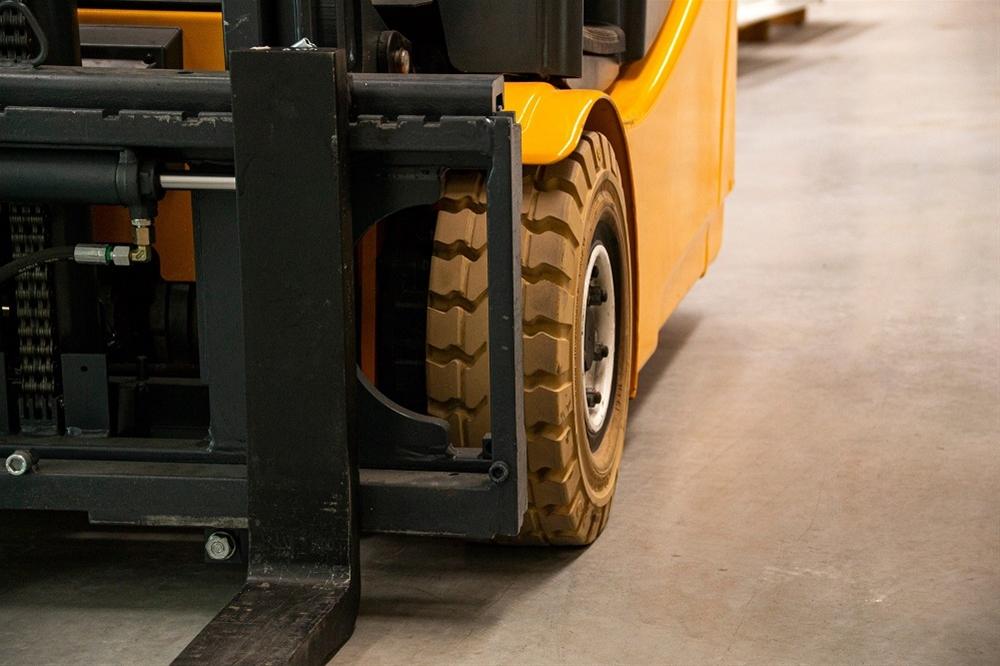
1. Concentrated Wheel Load
The weight of the forklift and its load is transmitted through relatively small wheel contact areas, creating higher localized stress than ordinary pedestrian traffic.
Coatings without adequate mechanical performance may wear, crack, or deteriorate faster in these locations.
The maximum loaded weight of the forklift should therefore be considered when selecting the flooring system.
2. Repeated Cycling Along Defined Paths
Forklifts often travel the same routes repeatedly between storage areas, production areas, loading docks, and staging zones.
This concentrates wear in predictable paths.
A floor can therefore remain relatively undamaged in low-traffic areas while forklift lanes show significant deterioration.
3. Turning and Braking Stress
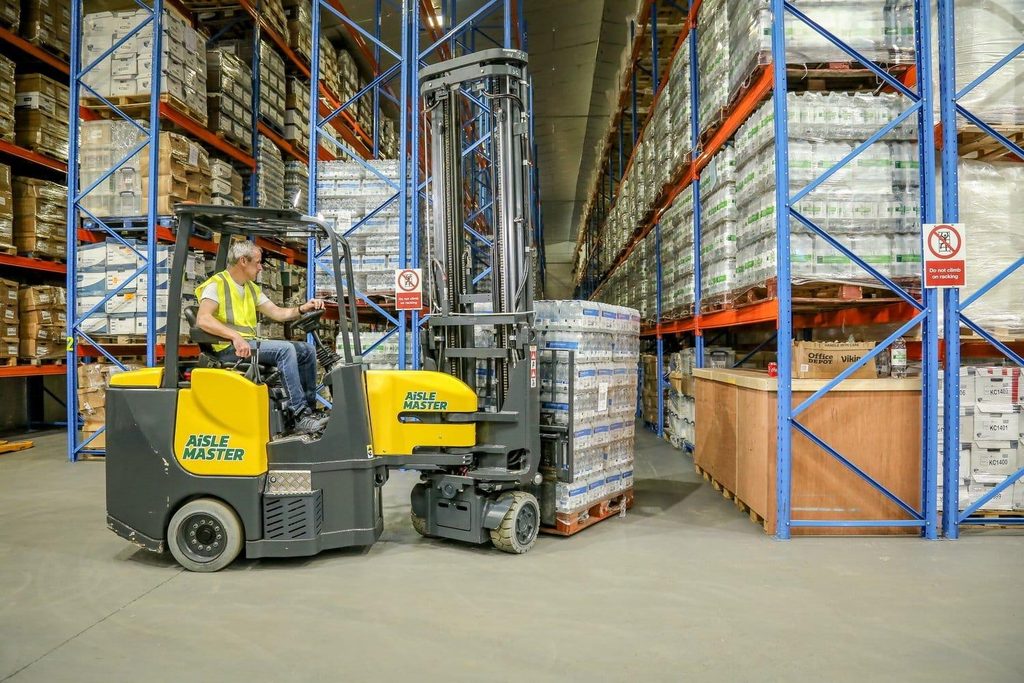
Turning introduces lateral forces at the tire-to-floor interface, while braking creates additional stress during rapid deceleration.
High-stress locations can include:
- Aisle ends
- Loading docks
- Warehouse intersections
- Sharp corners
- Ramps
- Staging areas
These areas may need additional consideration when specifying heavy-duty industrial flooring.
4. Tire Type and Contact Pressure
Forklift tires commonly include:
- Pneumatic tires
- Solid rubber tires
- Polyurethane tires
Different tire types create different contact conditions.
Solid and polyurethane tires can create more concentrated contact pressure because they deform less than pneumatic tires.
Therefore, tire type should be considered together with forklift weight, traffic frequency, and floor conditions.
5. Traffic Frequency and Duty Cycle
A forklift operating a few times a day creates a very different wear pattern from one operating continuously across multiple shifts.
Consider:
- Number of forklift movements per day
- Number of operating shifts
- Expected annual traffic
- Number of forklifts using the same route
- Planned future increases in warehouse activity
A flooring specification based only on current traffic may become inadequate if facility throughput increases.
What Type of Flooring Is Best for Forklift Traffic?
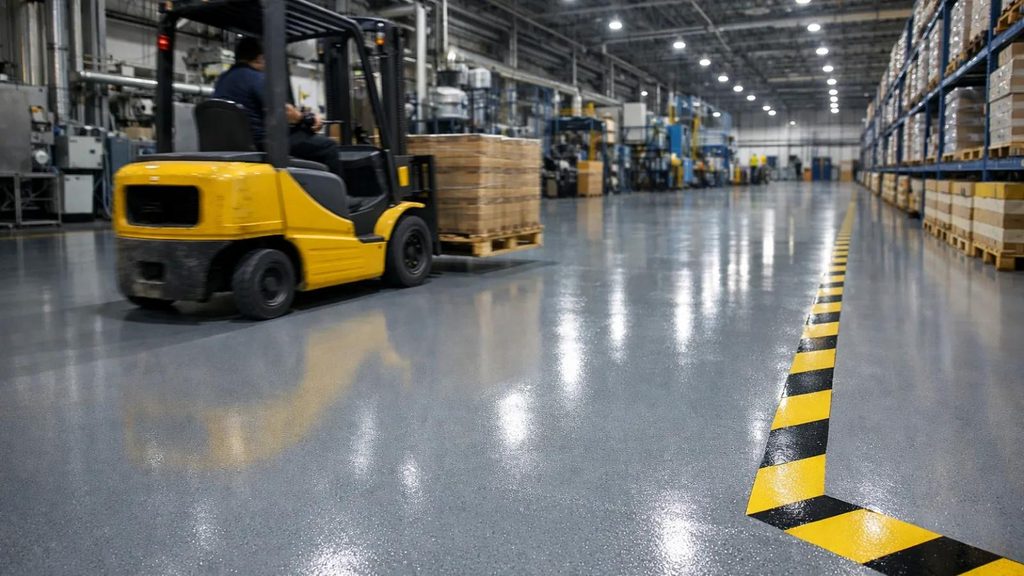
Heavy-Duty Epoxy Flooring
Heavy-duty epoxy flooring is widely used in industrial areas exposed to regular forklift traffic.
Depending on the formulation and specification, epoxy systems can provide:
- Abrasion resistance
- Mechanical durability
- Chemical resistance
- Seamless surfaces
- Easy cleaning
- Options for textured finishes
However, not every epoxy system is suitable for heavy forklift traffic. The formulation, thickness, surface preparation, substrate condition, and installation quality all matter.
Polyurethane Flooring
Polyurethane flooring can be considered where the floor requires a combination of mechanical performance, chemical resistance, thermal tolerance, or specific flexibility characteristics.
The appropriate polyurethane system depends on the actual operating environment.
It should not be assumed that polyurethane is automatically superior to epoxy for every forklift application.
Heavy-Duty Industrial Flooring Systems
Some demanding environments may require systems designed specifically for:
- Heavy impact
- Severe abrasion
- Chemical exposure
- Thermal shock
- Moisture
- Substrate movement
For these applications, the flooring should be selected according to the complete exposure profile rather than simply choosing a product described as “heavy duty.”
7 Factors to Consider When Choosing Forklift Flooring
1. Forklift Weight and Load Capacity
The important figure isn’t simply the forklift’s unloaded weight.
Consider the maximum loaded operating weight and how the load is transferred through the wheels.
Before specifying flooring, document:
- Forklift operating weight
- Maximum load capacity
- Maximum loaded weight
- Wheel configuration
- Tire type
- Frequency of operation
Where structural capacity is relevant, the concrete slab should be assessed separately by an appropriately qualified professional.
2. Forklift Tire Type
Tire material affects how the forklift interacts with the floor.
Pneumatic, solid rubber, and polyurethane tires have different deformation and contact characteristics.
Facilities using solid or polyurethane tires should ensure that the selected industrial floor coating is suitable for the actual wheel loads and traffic conditions.
3. Traffic Frequency
Traffic frequency has a major influence on flooring wear.
Consider both current and anticipated future traffic.
For example, a single-shift warehouse with occasional forklift movement may have substantially different requirements from a distribution center operating multiple shifts with continuous forklift traffic.
4. Turning and Braking
Turning and braking can produce additional lateral stress that isn’t present during straight-line travel.
Give particular attention to:
- Aisle ends
- Dock approaches
- Intersections
- Ramps
- Tight corners
- Staging areas
These areas may require enhanced durability or a suitable textured finish.
5. Concrete Substrate Condition
A high-performance coating cannot compensate for a structurally inadequate or deteriorating concrete slab.
Before installing flooring, assess:
- Cracks
- Delamination
- Surface weakness
- Joint condition
- Moisture
- Contamination
- Previous coatings
- Uneven areas
Proper concrete floor preparation is essential before applying an industrial coating system.
6. Chemical Exposure
Forklift areas can be exposed to:
- Hydraulic oil
- Lubricants
- Fuel
- Cleaning chemicals
- Battery-related chemicals
- Manufacturing fluids
The selected coating should be checked against the actual chemicals present rather than relying solely on a generic “chemical-resistant” description.
7. Slip Resistance and Surface Texture
Forklift areas can become slippery when exposed to water, oil, coolant, or cleaning solutions.
A properly selected anti-slip industrial flooring system can improve traction where required.
However, excessive texture may make cleaning more difficult.
The goal is to balance:
Slip resistance + cleanability + durability + forklift operability.
Forklift Flooring Zone Comparison
| Area | Typical Stress | Flooring Consideration |
| Main forklift aisles | Repeated wheel loads | Heavy-duty industrial system |
| Aisle ends | Turning and braking | Enhanced durability and traction |
| Loading docks | Impact, braking, traffic | Heavy-duty system with suitable texture |
| Ramps | Wheel loads and traction | High-durability, slip-resistant system |
| Staging areas | Forklift and pallet loads | Heavy-duty system based on traffic |
| Storage areas | Variable traffic and static loads | Specify according to actual use |
| Pedestrian walkways | Foot traffic | Standard industrial system may be sufficient |
| Offices | Minimal industrial traffic | Different flooring specification |
Applications: Where Forklift Flooring Matters Most
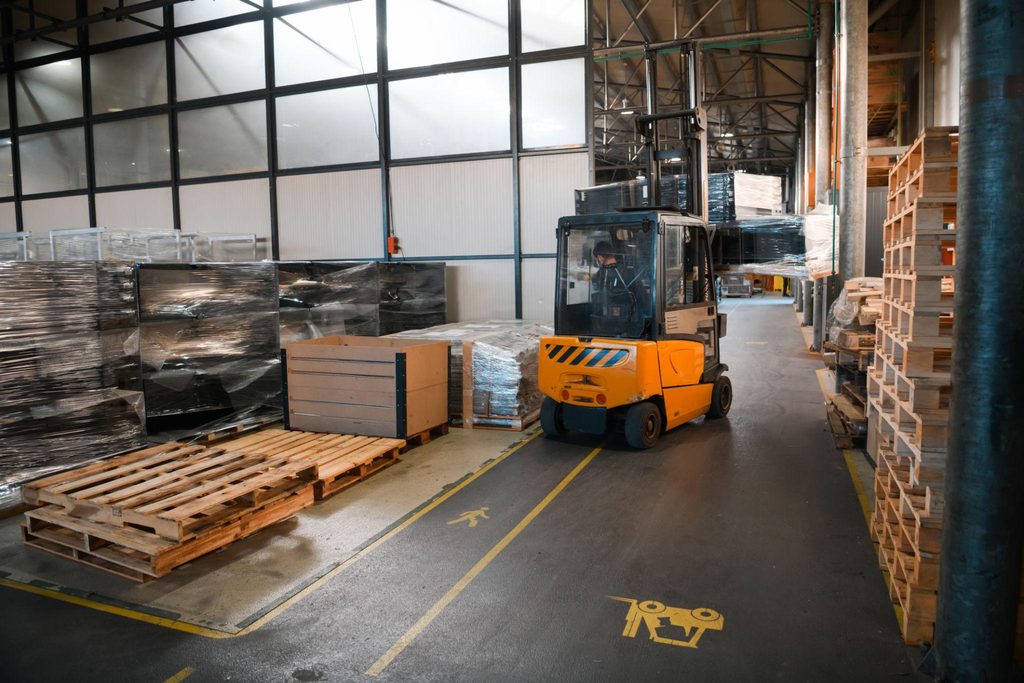
Warehouses
Warehouse flooring should account for predictable forklift routes, high traffic frequency, aisle turning, loading zones, and pallet movement.
Focus particularly on:
- Main aisles
- Cross-aisles
- Turning areas
- Dock approaches
- Ramps
- High-frequency staging zones
Distribution Centers
Distribution centers may experience very high forklift cycle counts, especially when operating multiple shifts.
In these facilities, abrasion resistance, impact resistance, maintenance planning, and traffic-zone specification become particularly important.
Manufacturing Facilities
Manufacturing facilities often combine forklift traffic with:
- Oil
- Coolants
- Metal debris
- Production chemicals
- Heavy equipment
- Frequent cleaning
The flooring should therefore be evaluated for both mechanical and chemical exposure.
Cold Storage Facilities
Cold-storage environments introduce additional considerations such as:
- Low temperatures
- Temperature changes
- Condensation
- Door thresholds
- Forklift traffic
The flooring system should be verified for the actual temperature and moisture conditions.
Forklift Traffic and Epoxy Flooring Thickness
A common question is:
How thick should epoxy flooring be for forklift traffic?
There is no universal thickness that is correct for every application.
Required system build depends on:
- Forklift weight
- Tire type
- Traffic frequency
- Concrete condition
- Impact exposure
- Chemical exposure
- Turning and braking
- Required service life
- Existing substrate
Epoxy flooring thickness should therefore be determined as part of the complete system specification.
More thickness does not automatically make an unsuitable flooring system suitable.
The complete system—including primer, intermediate coats, topcoat, aggregate, joint treatment, substrate preparation, and curing—should be considered.
Common Forklift Flooring Problems
Premature Wear in Forklift Lanes
Cause: Traffic intensity wasn’t adequately considered.
Result: Wheel paths become visibly worn while surrounding flooring remains in good condition.
Prevention: Identify traffic routes and select a system appropriate for the expected cycle count.
Cracking at Turning Points
Cause: Repeated lateral stress, substrate movement, joint issues, or inadequate detailing.
Result: Cracks or localized coating failure appear at aisle ends and turning zones.
Prevention: Assess these locations separately rather than treating them as ordinary floor areas.
Delamination
Cause: Poor surface preparation, moisture, contamination, substrate movement, or incompatibility between flooring layers.
Result: The coating loses adhesion and may lift under repeated traffic.
Prevention: Proper concrete surface preparation and substrate assessment are essential before installation.
Chemical Damage
Cause: The coating wasn’t compatible with the chemicals used in the facility.
Result: Softening, staining, discoloration, or degradation.
Prevention: Check chemical resistance against the actual substances used.
Slip Problems
Cause: Smooth flooring combined with water, oil, coolant, or cleaning liquids.
Result: Reduced traction for pedestrians and vehicle operators.
Prevention: Select an appropriate slip-resistant finish based on actual operating conditions.
How to Specify Flooring for Forklift Traffic
A practical specification process can follow these steps:
Step 1: Identify the Equipment
Record:
- Forklift type
- Operating weight
- Maximum load
- Tire type
- Wheel configuration
Step 2: Map Traffic Routes
Identify:
- Main aisles
- Turning points
- Loading areas
- Ramps
- Cross-aisles
- Staging areas
Step 3: Determine Traffic Frequency
Estimate daily and annual forklift movements and consider future increases.
Step 4: Inspect the Concrete
Assess cracks, joints, moisture, contamination, surface strength, and existing coatings.
Step 5: Identify Chemical Exposure
Document oils, fuels, cleaning agents, battery-related substances, and manufacturing chemicals.
Step 6: Select the Flooring System
Compare appropriate epoxy, polyurethane, or other industrial flooring systems based on the complete exposure profile.
Step 7: Specify High-Stress Zones Separately
Give additional consideration to turning points, ramps, docks, and other areas experiencing unusual wear.
Step 8: Confirm Installation Requirements
Ensure the flooring contractor understands:
- Surface preparation requirements
- System thickness
- Curing conditions
- Joint treatment
- Aggregate requirements
- Moisture limitations
- Maintenance requirements
Should the Whole Warehouse Have the Same Flooring?
Not necessarily.
A uniform flooring system can simplify specification, but it may not always be the most technically or economically appropriate approach.
A facility may have:
- Heavy forklift traffic in main aisles
- Occasional forklift traffic in storage areas
- Pedestrian-only walkways
- High-impact loading zones
- Chemical exposure near production areas
These areas don’t necessarily need identical flooring specifications.
A zone-based flooring approach can provide additional protection where it is actually required while avoiding unnecessary upgrades in low-stress areas.
Cost Considerations
Forklift-resistant flooring may cost more initially because it can require:
- Higher-performance materials
- Greater system thickness
- Additional surface preparation
- Aggregate broadcast
- Additional detailing
- Substrate repairs
However, initial installation cost should be considered alongside long-term maintenance.
Premature flooring failure can involve:
- Material and labor costs
- Traffic restrictions
- Production interruptions
- Partial-area recoating
- Maintenance scheduling
For this reason, the cheapest flooring system isn’t necessarily the lowest-cost option over its service life.
Expert Tips for Forklift Flooring
Tip 1: Don’t Specify Based Only on Forklift Weight
Loaded weight, tire type, traffic frequency, turning, braking, and impact all influence flooring performance.
Tip 2: Pay Special Attention to Aisle Ends
Turning areas can experience different stresses from straight travel lanes and deserve specific consideration.
Tip 3: Inspect the Concrete Before Selecting the Coating
If the substrate is unsuitable, upgrading the coating alone may not solve the problem.
Tip 4: Consider Future Traffic
If warehouse throughput is expected to increase, include that future demand in the flooring specification.
Tip 5: Don’t Ignore Chemical Exposure
Mechanical durability doesn’t automatically mean chemical compatibility.
Tip 6: Balance Traction With Cleanability
An excessively textured surface may improve traction but can become harder to clean and maintain.
Example: Flooring Specification for a Forklift Warehouse
Consider a distribution facility operating forklifts across two shifts.
The facility identifies three primary zones:
- Main aisles with continuous forklift movement
- Loading areas with frequent braking and turning
- Pedestrian and low-traffic areas
Instead of specifying the same system everywhere, the facility develops a zone-based flooring specification.
The main forklift aisles receive a heavy-duty industrial flooring system designed for repeated wheel traffic. Loading and turning areas receive additional attention to impact resistance and slip resistance. Low-traffic areas use a less demanding industrial flooring system.
This approach focuses investment on areas experiencing the greatest mechanical stress rather than applying the most intensive specification throughout the entire building.
Safety and Technical Considerations
Forklift flooring should be evaluated as part of the wider industrial environment.
Consider:
- Structural load capacity
- Concrete condition
- Joint movement
- Surface preparation
- Slip resistance
- Chemical compatibility
- Temperature
- Moisture
- Forklift tire characteristics
- Traffic frequency
Where structural capacity is uncertain, consult an appropriately qualified structural professional. Flooring coatings should not be treated as a substitute for structural design.
Frequently Asked Questions
What is the best flooring for heavy forklift traffic?
Heavy-duty epoxy and polyurethane systems are commonly considered for forklift areas, but the appropriate system depends on forklift weight, tire type, traffic frequency, substrate condition, chemical exposure, and required service life.
Does forklift tire type affect flooring selection?
Yes. Pneumatic, solid rubber, and polyurethane tires interact with the floor differently. Tire type should therefore be included in the flooring assessment.
Is epoxy flooring suitable for forklifts?
Yes, appropriately specified epoxy systems can be used in many forklift environments. However, the formulation, thickness, substrate preparation, and exposure conditions determine suitability.
Is polyurethane better than epoxy for forklift traffic?
Not automatically. Both systems can be suitable for different industrial environments. The correct choice depends on abrasion resistance, impact resistance, chemical resistance, flexibility, temperature performance, and other site conditions.
How thick should industrial flooring be for forklifts?
There is no single thickness suitable for every application. The complete flooring system should be designed according to actual forklift loads, traffic frequency, substrate condition, and environmental exposure.
Do turning forklifts damage floors more?
Turning can create additional lateral forces that may accelerate wear or coating failure, particularly at aisle ends, corners, and loading areas.
Can forklift traffic damage concrete?
Yes. Repeated wheel loads, impacts, joint movement, and heavy loading can contribute to concrete wear or deterioration when the slab, joints, or surface are not suitable for the operating conditions.
Should loading docks have different flooring?
Often, yes. Loading docks can experience concentrated traffic, braking, turning, impacts, moisture, and contamination, so they may warrant a more robust specification than low-traffic areas.
Can I use one flooring system throughout the warehouse?
You can, but it isn’t always necessary. A zone-specific specification may provide better value when traffic intensity varies significantly across the facility.
People Also Ask
- What flooring is best for a forklift warehouse?
- Is epoxy flooring suitable for heavy forklift traffic?
- How thick should epoxy flooring be for forklifts?
- Does polyurethane flooring last longer than epoxy?
- Do solid tire forklifts damage concrete floors?
- What causes forklift lanes to wear out?
- How can industrial floors be protected from forklift traffic?
- What flooring is best for loading dock areas?
- How do you repair forklift damage to epoxy flooring?
Conclusion
Forklift traffic can significantly influence industrial flooring performance because it combines repeated wheel loads, concentrated contact pressure, turning, braking, impact, and high traffic frequency.
The right flooring system should therefore be selected based on the actual operating environment rather than simply choosing a generic “heavy-duty” coating.
Before specifying flooring, evaluate the forklift’s loaded weight, tire type, traffic frequency, travel routes, turning areas, concrete condition, chemical exposure, and maintenance requirements.
For many industrial applications, heavy-duty epoxy or polyurethane systems can provide suitable performance when properly designed and installed. However, high-stress areas such as loading docks, ramps, turning points, and heavily used forklift aisles may require additional consideration.
The most effective approach is to match the flooring specification to the actual traffic conditions in each zone, while ensuring that the underlying concrete and joints are capable of supporting the required loads. This can improve service life, reduce maintenance disruption, and provide better long-term value for warehouses, distribution centers, and manufacturing facilities.