Choosing an industrial floor for a new factory is not simply a matter of selecting an epoxy product and comparing the price per square foot. The correct flooring system depends on traffic, wheel loads, chemicals, temperature, hygiene, static-control requirements, substrate condition, cleaning methods and expected service life.
A floor that performs well in an office or light-duty warehouse may fail quickly under forklifts, heavy machinery, chemical exposure or repeated washdown. The safest approach is therefore to select the flooring system from the factory’s actual operating conditions, then turn those requirements into a measurable specification before requesting quotations.
This guide explains the main industrial epoxy and resin flooring systems, how to choose between them, what thickness means, how installation works, what affects cost in Chennai, and which questions should be answered before a flooring specification is finalized.
Direct Answer
The right industrial epoxy flooring system should be selected according to the factory’s traffic intensity, forklift and machinery loads, chemical exposure, temperature, hygiene requirements, moisture conditions, slip resistance and electrical/static-control needs.
Standard epoxy can suit light-to-medium industrial traffic, while heavy-duty epoxy is generally more appropriate for frequent forklift and machinery traffic. Self-leveling systems are useful where a smooth, seamless surface is required; ESD systems are designed for controlled static dissipation; PU systems can be preferable where thermal shock and demanding washdown conditions are important; and chemical-resistant systems should be selected according to the actual chemicals present.
The final choice should be confirmed after substrate assessment and site inspection, rather than based on product name or price alone.
Quick Answer: Which Flooring System Should You Choose?
| Factory condition | Flooring system to consider | Main reason |
| Light-to-medium traffic | Standard epoxy | Cost-effective protection for moderate use |
| Frequent forklifts | Heavy-duty epoxy | Greater abrasion and impact resistance |
| Smooth, easy-to-clean production area | Self-leveling epoxy | Seamless and uniform finish |
| Electronics/static-sensitive area | ESD flooring | Controlled static dissipation |
| Electrical insulation requirement | Dielectric flooring | High electrical resistance |
| Hot-water or steam washdown | PU flooring | Better thermal-shock tolerance |
| Aggressive chemical exposure | Chemical-resistant epoxy/PU | Resistance matched to specific chemicals |
| Freezer/cold-chain area | Low-temperature resin system | Designed for cold and thermal cycling |
| Food/pharma hygiene areas | Hygiene-grade epoxy/PU | Seamless, cleanable and detail-friendly |
| Mixed-use factory | Zone-specific systems | Prevents over- or under-specification |
Important: This table is a starting point, not a final engineering specification. Product formulation, thickness, substrate condition and installation quality can substantially change actual performance.
What Is Industrial Epoxy Flooring?
Industrial epoxy flooring is a resin-based flooring system applied over prepared concrete to create a bonded, continuous surface with properties such as abrasion resistance, chemical resistance, easier cleaning and improved durability.
Unlike conventional floor paint, an industrial epoxy system is normally built in layers. Depending on the specification, this can include:
- Primer
- Body or build coat
- Intermediate coat
- Aggregate or reinforcement
- Topcoat
The finished thickness can vary considerably depending on the system and application. A light coating and a heavy-duty resin screed are not equivalent simply because both are described as “epoxy flooring.”
The performance of the finished floor depends on more than the resin itself. Concrete quality, moisture, surface preparation, film thickness, application conditions, curing and maintenance all matter.
Why Does Factory Flooring Need to Be Specified Carefully?
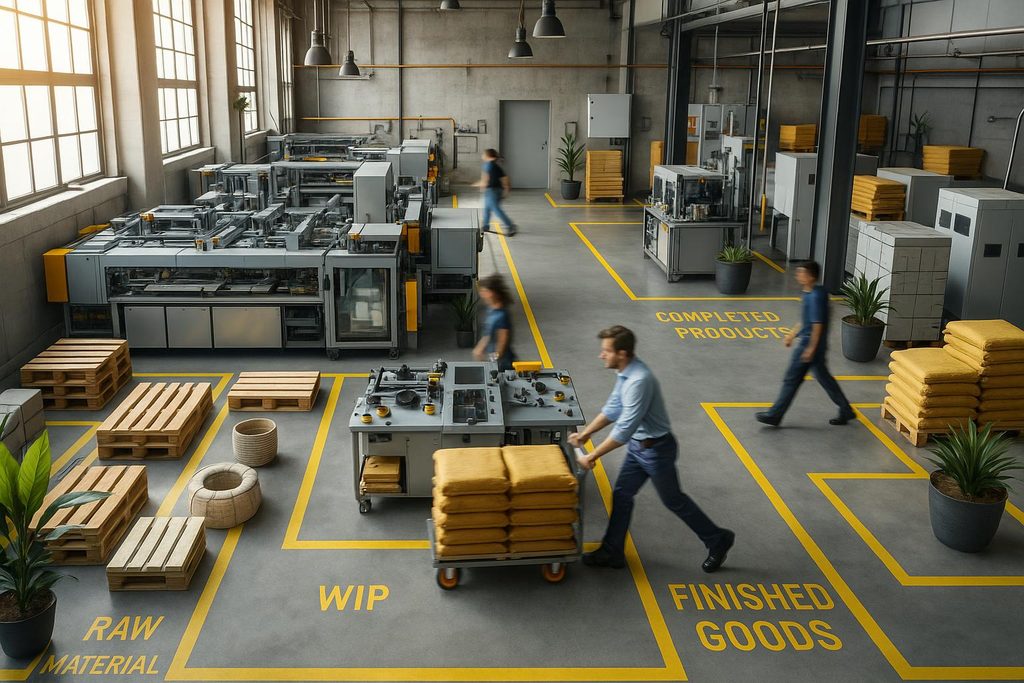
A factory floor is exposed to forces that ordinary commercial floors may never experience.
Forklifts create concentrated wheel loads. Machinery can produce point loading and vibration. Chemicals can attack the resin or concrete. Washdown introduces water and cleaning chemicals. Temperature changes can create thermal stress. Production processes can also introduce requirements for hygiene, static control or slip resistance.
The problem
A specification such as:
“Provide durable chemical-resistant epoxy flooring.”
does not tell a contractor enough.
It doesn’t define:
- which chemicals
- what traffic
- what thickness
- what preparation
- what slip resistance
- what static-control performance
- what temperature range
- what testing is required
The better approach
Define the operating conditions first, then select the flooring system that meets those requirements.
This makes contractor quotations more comparable and reduces the risk of installing a floor that is technically acceptable but unsuitable for the actual factory.
Which Industrial Flooring System Is Right for Your Factory?
1. Standard Epoxy Flooring
What is it?
A general-purpose epoxy coating system designed for light-to-medium industrial traffic.
Suitable applications
- Light manufacturing
- Workshops
- Storage areas
- Walkways
- Low-to-moderate forklift traffic
- General factory areas
Advantages
- Good general abrasion resistance
- Good chemical resistance for many common exposures
- Seamless finish
- Easier cleaning than bare concrete
- Generally more economical than high-build systems
Limitations
It may not be appropriate for continuous heavy forklift traffic, severe impact, aggressive chemicals or extreme thermal cycling.
Choose it when
The area has moderate traffic and the environmental conditions don’t require a specialized resin system.
2. Heavy-Duty Epoxy Flooring
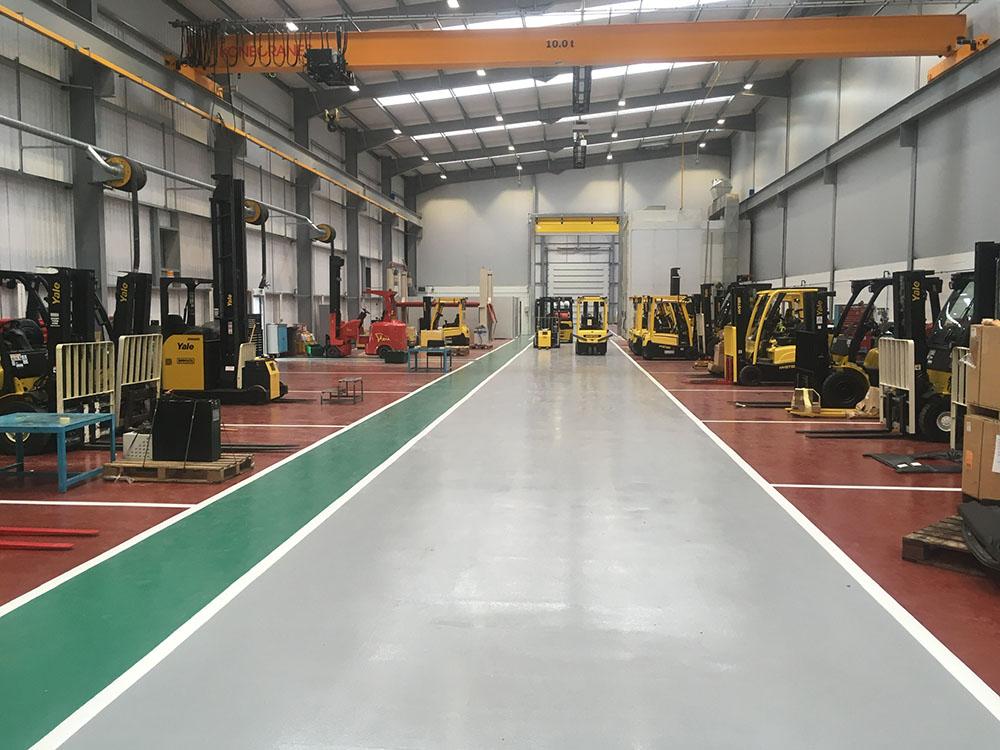
Heavy-duty epoxy systems use greater build thickness and/or reinforced aggregate systems to provide increased mechanical performance.
Suitable applications
- Automotive plants
- Engineering factories
- Machine shops
- Heavy manufacturing
- Forklift lanes
- Warehouses
- Equipment areas
Consider it when the floor experiences:
- Frequent forklifts
- Heavy pallet trucks
- Point loading
- Dropped components
- Abrasive materials
- Repeated mechanical traffic
The important point is that heavy-duty flooring should be selected from the actual loading conditions, rather than simply specifying the thickest available coating.
3. Self-Leveling Epoxy Flooring
Self-leveling epoxy is a flowable resin system designed to produce a smooth, continuous surface.
Common applications
- Pharmaceutical facilities
- Electronics production
- Laboratories
- Clean areas
- QA areas
- Selected food-processing environments
Advantages
- Smooth appearance
- Seamless finish
- Easy cleaning
- Uniform surface
- Useful where floor cleanliness is important
Limitation
Self-leveling material does not eliminate the need for proper substrate preparation. Cracks, moisture and weak concrete must still be addressed.
4. ESD / Anti-Static Epoxy Flooring
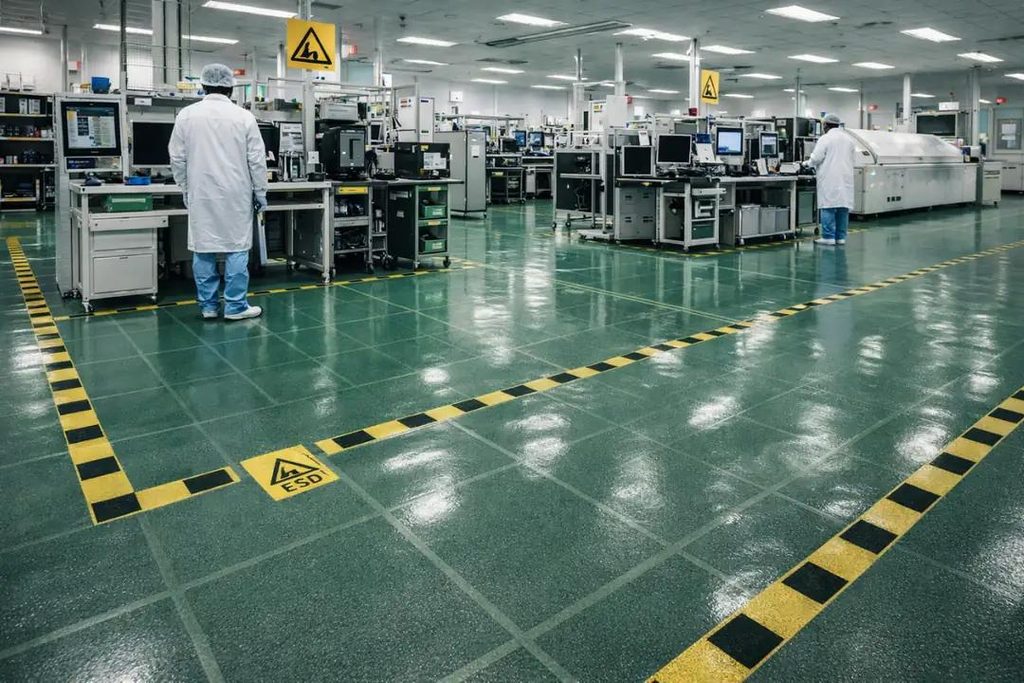
ESD flooring is designed to control and dissipate electrostatic charge in areas where static electricity must be managed.
Common applications
- Electronics manufacturing
- Semiconductor facilities
- PCB assembly
- Battery manufacturing
- Static-sensitive laboratories
- Certain pharmaceutical environments
Important distinction
“Anti-static” should not be treated as a sufficient technical specification by itself.
The project should define:
- required electrical performance
- grounding arrangement
- resistance requirements
- test method
- acceptance criteria
- maintenance/testing requirements
ESD flooring is part of an overall electrostatic-control strategy; the flooring itself should not be treated as the sole safety measure for hazardous environments.
5. Dielectric Flooring
Dielectric flooring is designed to provide high electrical resistance.
It serves a different purpose from ESD flooring.
ESD flooring
Dissipates static charge.
Dielectric flooring
Provides electrical insulation.
They should therefore never be treated as interchangeable options.
For projects involving electrical equipment, switchgear or other energized systems, the appropriate electrical safety requirements should be established with the responsible electrical/safety professionals before the flooring is specified.
6. Polyurethane (PU) Flooring
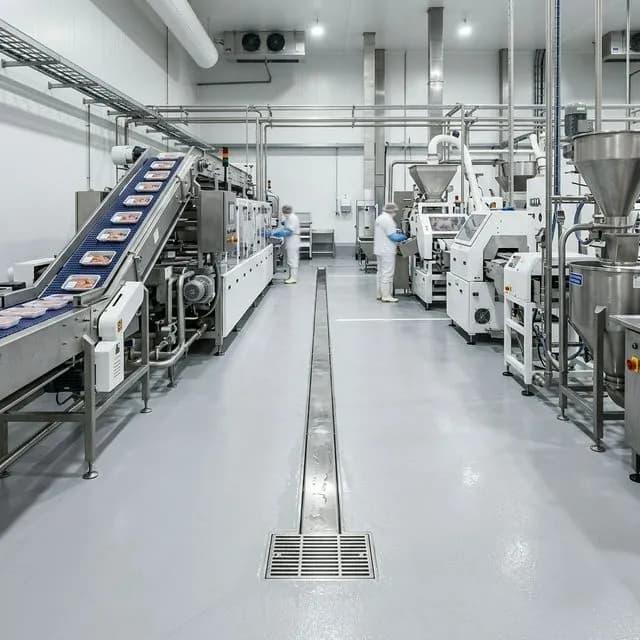
Polyurethane flooring can be a strong candidate where the floor experiences thermal shock, demanding washdown or certain chemical exposures.
Common applications
- Food processing
- Beverage plants
- Commercial kitchens
- Processing areas
- Washdown zones
- Areas with temperature cycling
Why consider PU?
PU systems can offer better tolerance of certain thermal stresses than conventional epoxy systems.
For example, a production area exposed to:
cold floor → hot water washdown → cooling → repeated cycle
may require a different resin system from a dry warehouse.
7. Chemical-Resistant Flooring
Chemical-resistant flooring should never be specified simply as:
“acid-resistant epoxy.”
Chemical resistance is chemical-specific.
The specification should identify:
- chemical name
- concentration
- temperature
- frequency of exposure
- contact duration
- cleaning chemicals
- expected spill conditions
The proposed resin system should then be checked against the manufacturer’s chemical-resistance data.
Typical applications
- Chemical plants
- Laboratories
- Battery facilities
- Process areas
- Chemical storage rooms
- Manufacturing plants
8. Cold Storage Flooring
Cold-storage floors require consideration of:
- operating temperature
- temperature cycling
- freezer doors
- moisture
- installation temperature
- curing conditions
- thermal movement
A system suitable for normal ambient conditions should not automatically be assumed suitable for sustained sub-zero operation.
Cold-room flooring should therefore be specified against the actual operating temperature and thermal cycle.
9. Hygiene Flooring
Hygiene-focused resin flooring is commonly considered for:
- Food processing
- Pharmaceutical manufacturing
- Clean production areas
- Laboratories
- Healthcare-related environments
The flooring system is only one part of the hygiene design.
The specification may also need:
- seamless transitions
- wall coving
- appropriate drainage
- correct falls
- sealed penetrations
- compatible cleaning procedures
In washdown environments, good flooring without appropriate drainage and detailing can still create operational problems.
Industrial Flooring Comparison
| Flooring system | Best suited for | Main strength | Important limitation |
| Standard epoxy | Light/medium industrial traffic | Cost-effective general protection | Not ideal for severe mechanical conditions |
| Heavy-duty epoxy | Forklifts and heavy machinery | Mechanical and abrasion resistance | Higher material/labour requirement |
| Self-leveling epoxy | Smooth, cleanable areas | Seamless uniform surface | Requires sound substrate |
| ESD flooring | Electronics/static-sensitive areas | Static dissipation | Requires electrical testing/grounding |
| Dielectric flooring | Electrical insulation applications | High electrical resistance | Opposite function to ESD |
| PU flooring | Washdown/thermal cycling | Thermal-shock performance | System selection can be more specialized |
| Chemical-resistant system | Chemical exposure | Resistance to specified chemicals | Must be matched to actual chemicals |
| Cold-storage system | Freezer/cold-chain areas | Low-temperature performance | Installation conditions need planning |
| Hygiene flooring | Food/pharma environments | Seamless, cleanable finish | Drainage/detailing must also be addressed |
Exact performance varies by manufacturer, formulation, thickness, substrate and installation method. Product technical data should be used for final specification.
How to Choose the Right Industrial Flooring for a New Factory
The most reliable selection process starts with how the floor will actually be used.
1. Identify the Factory’s Industry
Different industries create different requirements.
Pharmaceutical
Consider:
- hygiene
- cleanability
- chemical exposure
- seamless detailing
- coving
- contamination control
Electronics
Consider:
- ESD requirements
- resistance range
- grounding
- testing
- static-sensitive processes
Food and Beverage
Consider:
- washdown
- cleaning chemicals
- thermal shock
- drainage
- hygiene
- slip resistance
Automotive and Heavy Manufacturing
Consider:
- forklifts
- machinery
- oils
- coolants
- impact
- point loading
Chemical Manufacturing
Consider:
- specific chemical exposure
- concentration
- temperature
- spill duration
- cleaning chemicals
Warehousing and Logistics
Consider:
- forklift frequency
- wheel loads
- pallet trucks
- turning areas
- racking loads
- abrasion
Cold Storage
Consider:
- minimum operating temperature
- thermal cycling
- condensation
- freezer traffic
- curing conditions
2. Map the Factory Into Functional Zones
One of the biggest mistakes is specifying one flooring system for an entire factory simply because it is easier to procure.
Instead, divide the building into zones.
For example:
| Zone | Main conditions | Potential flooring |
| Production | Machinery + forklift traffic | Heavy-duty epoxy |
| Chemical store | Chemical exposure | Chemical-resistant resin |
| QA area | Foot traffic + cleanability | Standard/self-leveling epoxy |
| Washdown area | Water + chemicals + thermal cycling | PU/hygiene system |
| Electronics area | Static-sensitive work | ESD flooring |
| Warehouse | Forklifts + pallets | Heavy-duty epoxy |
This zone-based approach can reduce unnecessary spending while ensuring demanding areas receive the performance they need.
3. Assess Traffic and Wheel Loads
Don’t ask only:
“Is there forklift traffic?”
Ask:
- How many forklift movements per day?
- What is the maximum loaded weight?
- What type of wheels are used?
- Where do forklifts turn?
- Are pallet trucks used?
- Are heavy machines moved?
- Are materials dragged across the surface?
A small number of heavy wheel loads can be more demanding than continuous pedestrian traffic.
4. Identify Point Loads
Floor performance isn’t determined only by moving traffic.
Also consider:
- machine feet
- racking legs
- storage racks
- equipment bases
- heavy containers
- concentrated loads
Where loads are substantial, both the coating and underlying concrete slab may need engineering review.
5. List the Actual Chemicals
Don’t write:
Chemical-resistant flooring.
Instead create a chemical inventory.
For example:
| Chemical | Concentration | Temperature | Exposure |
| Cleaning chemical | X% | Ambient | Daily |
| Process chemical | X% | Ambient | Occasional |
| Oil/coolant | — | Ambient | Continuous |
| Solvent | X% | Ambient | Spill |
Then ask the flooring manufacturer or contractor to confirm compatibility against the proposed system.
Cleaning chemicals matter just as much as process chemicals.
6. Check Temperature Conditions
Document:
- normal operating temperature
- maximum temperature
- minimum temperature
- hot-water washdown temperature
- steam exposure
- freeze/thaw cycles
- thermal shock frequency
This can determine whether conventional epoxy is appropriate or whether a different resin system should be evaluated.
7. Check Moisture Before Selecting the System
A floor can look dry while moisture vapour remains a problem beneath the surface.
Before coating, establish:
- concrete age
- curing status
- moisture condition
- previous coatings
- contamination
- cracks
- concrete strength
- surface condition
Appropriate moisture testing should be defined for the project rather than relying on visual inspection.
8. Define Slip Resistance
A smooth, glossy floor may be easy to clean, but that doesn’t mean it is appropriate for every wet or oily environment.
Areas exposed to:
- water
- oil
- chemicals
- food products
- washdown
may require an appropriately textured or slip-resistant finish.
The required test method and acceptance criteria should be established for the specific application and region.
9. Determine ESD or Electrical Requirements
Do not use:
“anti-static floor”
as the entire specification.
Determine whether the facility actually requires:
ESD/static dissipation
or
electrical insulation/dielectric performance.
They solve different problems.
10. Consider Cleaning and Maintenance
Ask how the floor will actually be cleaned.
Is it:
- dry swept?
- machine scrubbed?
- chemically cleaned?
- pressure washed?
- steam cleaned?
The maintenance regime should be compatible with the resin system and topcoat.
How Thick Should Industrial Epoxy Flooring Be?
There is no universal “best” thickness.
A common mistake is assuming:
thicker = better.
Thickness is important, but it is only one part of system performance.
The specification should consider:
- resin chemistry
- aggregate
- substrate strength
- surface preparation
- traffic
- impact
- wheel loads
- chemical exposure
- temperature
- required service life
- installation method
A properly designed 3 mm system can be more appropriate than an incorrectly selected 6 mm system.
Therefore, specify the complete system and performance requirement, not thickness alone.
Epoxy vs PU Flooring for Factories
Neither material is universally better.
| Factor | Epoxy | PU |
| Mechanical durability | Strong | Strong |
| General industrial use | Excellent | Excellent |
| Thermal shock | More limited in some systems | Often better suited |
| Hot washdown | System-dependent | Often preferred |
| Chemical resistance | Good to excellent depending on formulation | Good to excellent depending on formulation |
| Cost | Often economical | Often higher |
| Temperature cycling | Application-specific | Often advantageous |
The final choice should be based on the operating conditions and specific product data, rather than assuming that one resin is always superior.
How Is Industrial Epoxy Flooring Installed?
A typical installation sequence includes:
1. Site inspection
Assess the floor, usage conditions and existing defects.
2. Substrate assessment
Review concrete strength, moisture and surface condition.
3. Surface preparation
Depending on the substrate and specification, preparation may include:
- diamond grinding
- shot blasting
- mechanical preparation
- removal of old coatings
- contamination removal
4. Cleaning
Remove dust and contaminants before coating.
5. Crack and joint treatment
Repair cracks and appropriately treat construction/expansion joints.
6. Primer
Apply the specified primer to promote adhesion and control the substrate.
7. Build coats
Apply the specified body/intermediate layers to achieve the required system build.
8. Topcoat
Apply the specified final layer for chemical resistance, slip resistance, appearance or other required properties.
9. Curing
Allow the system to cure according to the manufacturer’s requirements.
10. Quality inspection
Depending on the specification, inspect:
- appearance
- DFT
- adhesion
- surface defects
- resistance properties for ESD systems
11. Handover
Provide agreed test records, product information, maintenance guidance and warranty documentation.
Actual cure times depend on the product, temperature, humidity and site conditions. They should always be taken from the relevant technical data sheet.
Industrial Epoxy Flooring Cost in Chennai
There is no reliable single Chennai price for “industrial epoxy flooring” because two projects described with the same words can have completely different specifications.
Current Chennai listings show substantial price variation: examples include approximately ₹40/sq ft for an industrial flooring service, around ₹65/sq ft for a listed 1–3 mm industrial system, and around ₹100/sq ft for a listed 4 mm industrial epoxy product/service. These are supplier/listing prices, not a standardized market rate, and should not be treated as quotations for a specific factory.
What actually determines project cost?
- Floor area
- System type
- Required thickness
- Surface preparation
- Concrete condition
- Crack repair
- Existing coating removal
- Number of coats
- Aggregate requirements
- Chemical resistance
- ESD requirements
- Slip resistance
- PU vs epoxy
- Coving
- Joint treatment
- Drainage/detailing
- Working-hour restrictions
- Production shutdown requirements
- Testing and documentation
Why shouldn’t you compare only ₹/sq ft?
Suppose Contractor A quotes a lower price using:
- lighter preparation
- thinner coating
- fewer coats
while Contractor B includes:
- mechanical preparation
- moisture assessment
- thicker build
- additional coats
- testing
The two prices aren’t actually comparable.
Compare the specification before comparing the price.
For a factory project, the best quotation is a like-for-like quotation against the same technical scope.
Industrial Flooring in Chennai: Local Project Considerations
Factories in and around Chennai can involve demanding combinations of humidity, new concrete slabs, production traffic, chemical exposure and restricted installation windows.
For a Chennai factory project, the assessment should therefore consider:
- concrete moisture
- ambient temperature and humidity
- curing conditions
- production schedules
- forklift traffic
- chemical exposure
- washdown
- drainage
- substrate preparation
- availability of shutdown windows
The local market includes contractors and suppliers offering epoxy, PU, ESD, heavy-duty and other industrial systems, so buyers should compare technical scope and project experience, not just headline pricing.
Common Industrial Flooring Failures
Poor Surface Preparation
Cause: Coating applied over laitance, contamination, weak concrete or inadequate mechanical profile.
Result: Poor adhesion, peeling or delamination.
Prevention: Specify the preparation method and substrate acceptance criteria before coating.
Moisture Problems
Cause: Coating installed over a substrate with unacceptable moisture conditions.
Result: Blistering, bubbling or delamination.
Prevention: Establish appropriate moisture testing before installation.
Wrong Flooring System
Cause: Standard epoxy selected for heavy traffic, thermal shock, ESD or aggressive chemical exposure.
Result: Premature wear or failure to meet the required function.
Prevention: Select the system from actual operating conditions.
Incorrect Thickness
Cause: Applying less material than the specified system requires.
Result: Reduced durability and shorter service life.
Prevention: Specify DFT and coat build and verify it during installation.
Poor Application
Cause: Incorrect mixing, unsuitable ambient conditions or rushed application.
Result: Uneven finish, weak areas or inconsistent performance.
Prevention: Follow the product manufacturer’s application requirements and document quality checks.
Insufficient Curing
Cause: Forklifts or heavy equipment returned before the coating has reached the required cure.
Result: Indentation, surface damage and premature wear.
Prevention: Include return-to-service requirements in the project schedule.
Incorrect Joint Treatment
Cause: Construction or movement joints ignored during coating installation.
Result: Reflective cracking.
Prevention: Identify and detail joints before work starts.
Incompatible Maintenance
Cause: Incorrect chemicals, abrasive cleaning or unsuitable equipment.
Result: Topcoat deterioration and premature loss of performance.
Prevention: Provide a written maintenance procedure at handover.
How to Write a Factory Flooring Specification
Once you know what flooring your factory needs, the next step is turning that decision into a measurable scope.
Your specification should document:
- Site and substrate conditions
- Functional floor zones
- Traffic and loads
- Chemical exposure
- Temperature
- Hygiene requirements
- Slip resistance
- ESD/electrical requirements
- Coating type
- DFT
- Number of coats
- Surface preparation
- Joint treatment
- Coving and drainage
- Quality checks
- Cure requirements
- Handover testing
- Maintenance requirements
For a detailed project-ready checklist, see our Industrial Flooring Specification Checklist for Factory Projects.
How to Choose an Industrial Flooring Contractor
Once the specification is ready, don’t select the contractor solely on the lowest quotation.
Ask:
- Have you completed projects similar to ours?
- How will you assess the substrate?
- What preparation method will you use?
- Why are you recommending this flooring system?
- What DFT and coat build are proposed?
- What does the warranty cover?
- Can you provide relevant project references?
- How will you work around production?
- What quality checks occur during installation?
- What documentation will we receive?
- How are unexpected substrate problems handled?
- What maintenance support is provided?
The contractor’s ability to answer these questions specifically can reveal more than a polished sales proposal.
For the complete evaluation process, see our 12 Questions to Ask Before Choosing an Industrial Flooring Contractor.
Industrial Flooring by Factory Application
Manufacturing Floors
Prioritize:
- mechanical durability
- abrasion resistance
- impact resistance
- forklift traffic
- oils and coolants
Heavy-duty epoxy may be appropriate in high-traffic zones.
Chemical Storage
Prioritize:
- chemical-specific resistance
- spill conditions
- cleaning chemicals
- drainage
- containment requirements
Select the resin system against actual chemical data.
Electronics Manufacturing
Prioritize:
- ESD requirements
- grounding
- resistance testing
- contamination control
Use a properly specified ESD system where required.
Food Processing
Prioritize:
- hygiene
- washdown
- drainage
- thermal shock
- slip resistance
- cleaning chemicals
PU or specialized hygiene systems may be appropriate depending on the operating conditions.
Pharmaceutical Manufacturing
Prioritize:
- cleanability
- chemical exposure
- seamless detailing
- coving
- contamination control
- applicable regulatory requirements
Warehouses
Prioritize:
- forklift frequency
- wheel loads
- turning areas
- pallet trucks
- racking loads
Cold Storage
Prioritize:
- low-temperature performance
- thermal cycling
- moisture
- installation conditions
- loading areas
Benefits of Correctly Specified Industrial Flooring
Better Cost Comparisons
When every contractor prices the same DFT, preparation method, coat build and performance requirements, quotations become much easier to compare.
Lower Failure Risk
Proper substrate assessment and system selection reduce the risk of problems associated with moisture, adhesion, chemical attack and mechanical wear.
Better Operational Performance
The floor is selected for the way the factory actually operates rather than for a generic description such as “industrial epoxy.”
Easier Maintenance
A correctly selected seamless resin floor can simplify cleaning and routine maintenance.
Better Long-Term Value
A lower initial price can become expensive if the floor requires premature repair or replacement.
The right comparison is therefore:
Initial cost + maintenance + downtime + expected service life
rather than simply:
₹/sq ft
A Practical Factory Flooring Decision Process
Use this sequence before finalizing the flooring specification:
Step 1 — Map the floor
Divide the factory into functional zones.
Step 2 — Document operating conditions
Record traffic, loads, chemicals, temperature, cleaning and hygiene requirements.
Step 3 — Assess the substrate
Check concrete condition, moisture, cracks, contamination and strength.
Step 4 — Establish performance requirements
Define:
- DFT
- chemical resistance
- slip resistance
- static control
- load requirements
- temperature requirements
Step 5 — Select the system
Choose epoxy, PU, ESD, chemical-resistant or another resin system according to the documented requirements.
Step 6 — Prepare the specification
Turn the requirements into measurable installation and acceptance criteria.
Step 7 — Request comparable quotations
Give every contractor the same specification.
Step 8 — Assess contractors
Compare technical approach, experience, references, warranty and project planning.
Step 9 — Agree on testing
Define quality checks before installation begins.
Step 10 — Plan handover
Agree on cure times, testing, documentation, maintenance and warranty requirements.
Typical Factory Application Example
The following is a representative example, not a specific client project.
A new manufacturing facility has three main zones:
Machining area
The area has frequent forklift traffic, machinery and metal components.
Requirement: High mechanical and abrasion resistance.
Potential system: Heavy-duty epoxy.
Chemical storage area
The area contains cutting fluids and cleaning chemicals.
Requirement: Chemical resistance matched to the actual substances stored.
Potential system: Chemical-resistant epoxy or PU system, subject to compatibility review.
QA/office area
The area has mostly pedestrian traffic.
Requirement: Clean, durable and easy-to-maintain surface.
Potential system: Standard or self-leveling epoxy, depending on the required finish.
Instead of specifying one heavy-duty system throughout the building, the facility can use a zone-based specification.
That approach can avoid paying for unnecessary performance in low-demand areas while protecting the areas exposed to the greatest stresses.
Standards, Testing and Technical Considerations
Industrial flooring specifications may refer to different standards depending on the project, product and jurisdiction.
Moisture
Concrete moisture testing can involve methods such as ASTM F1869 and ASTM F2170. The applicable method and acceptance criteria should be established for the project rather than copied into a specification without context.
ESD
ESD flooring should be specified with the required electrical performance, grounding arrangement and testing criteria. IEC 61340-5-1 may be relevant to the broader static-control program.
Slip Resistance
Select an appropriate recognized test method based on the facility’s wet/dry conditions, region and intended use.
Concrete
The substrate should be assessed for:
- soundness
- strength
- moisture
- contamination
- surface profile
- cracks
- existing coatings
Important
Standards should not be used as decorative references in a flooring specification. Each referenced standard should have a clear purpose and acceptance criterion.
For regulated facilities, confirm applicable requirements with the relevant technical, safety or regulatory professionals.
Expert Insights
Expert Tip
Specify for the heaviest frequent traffic, not the average traffic.
If forklifts use only one section of an otherwise light-duty warehouse, that lane may require a different system from the rest of the building.
Professional Recommendation
Don’t approve the flooring system before understanding the substrate.
A premium resin system cannot compensate for weak, contaminated or excessively moist concrete.
Important Consideration
Thickness is not performance by itself.
Resin chemistry, aggregate, preparation, substrate quality, application and curing all influence the final result.
Expert Tip
List cleaning chemicals as well as production chemicals.
A floor may tolerate a process chemical but be damaged by a cleaning chemical used every day.
Professional Recommendation
Specify by zone where factory conditions differ.
One flooring system across the whole facility may be convenient to procure but technically unnecessary.
Frequently Asked Questions
What is the best epoxy flooring for a factory?
There is no single best system for every factory. Standard epoxy may suit moderate traffic, while heavy-duty epoxy, ESD, PU or chemical-resistant systems may be more appropriate for specialized conditions.
What flooring is best for heavy forklift traffic?
A heavy-duty resin flooring system is commonly considered for frequent forklift traffic, but the final specification should account for wheel loads, turning frequency, impact and substrate strength.
Is epoxy or PU better for factory flooring?
Neither is universally better. Epoxy is widely used for mechanical durability and general industrial applications, while PU can be advantageous where thermal shock, washdown or particular chemical exposures are important.
How thick should industrial epoxy flooring be?
There is no universal thickness. The required build depends on traffic, loading, substrate, chemical exposure, system type and expected service life.
What causes industrial epoxy flooring to peel?
Common causes include inadequate surface preparation, moisture, contamination, weak concrete, incorrect application and unsuitable system selection.
Can epoxy flooring be installed over old concrete?
Yes, if the existing concrete is suitable and properly assessed and prepared. Moisture, contamination, cracks, weak areas and existing coatings need to be addressed before installation.
Is ESD flooring the same as dielectric flooring?
No. ESD flooring is designed to dissipate static electricity, while dielectric flooring is designed to provide electrical insulation. They perform different functions.
Is industrial epoxy flooring suitable for chemical plants?
It can be, but chemical resistance must be checked against the actual chemicals, concentrations, temperatures and exposure conditions. A generic “chemical-resistant” claim is insufficient.
Is epoxy flooring suitable for cold storage?
Some resin systems are suitable for cold-storage environments, but the system must be selected for the actual operating temperature and thermal cycling conditions.
How much does industrial epoxy flooring cost in Chennai?
There is no meaningful single rate. Current Chennai listings show widely varying indicative prices depending on thickness and system, but factory pricing should be based on the actual specification, substrate condition and site requirements.
How can I compare industrial flooring quotations?
Give all contractors the same technical specification and compare:
- preparation
- DFT
- coat count
- resin system
- testing
- warranty
- curing schedule
- exclusions
Don’t compare only the final ₹/sq ft figure.
Can the same flooring system be used throughout a factory?
It can, but it isn’t always the best approach. Different zones may have substantially different traffic, chemical, hygiene, temperature or electrical requirements.
People Also Ask / Related Questions
- How do I choose industrial epoxy flooring?
- What is the best flooring for a manufacturing plant?
- How thick should factory epoxy flooring be?
- What is the difference between epoxy and PU flooring?
- What flooring is best for forklift traffic?
- What flooring is suitable for chemical plants?
- Is ESD flooring necessary for electronics manufacturing?
- What causes epoxy flooring to fail?
- How much does industrial epoxy flooring cost in Chennai?
- How do I compare industrial flooring contractors?
- What should an industrial flooring specification include?
Conclusion
Industrial epoxy flooring should not be selected simply by product name, thickness or price.
The correct system starts with the factory’s operating conditions: traffic, forklift loads, machinery, chemicals, temperature, hygiene, moisture, cleaning, slip resistance and electrical requirements.
From there, the floor can be divided into functional zones and each zone given an appropriate performance specification. Standard epoxy may be sufficient for moderate-use areas, while heavy-duty epoxy, self-leveling systems, ESD flooring, PU, chemical-resistant systems or cold-storage solutions may be appropriate where operating conditions demand them.
The most important principle is:
Specify the performance the factory needs, then select the flooring system that can reliably deliver it.
Before requesting quotations, assess the substrate and document the requirements. Then issue the same specification to each contractor so their proposals can be compared on a genuine like-for-like basis.