Introduction
Walk into any food processing plant, commercial bakery, or craft brewery, and you will see an environment that is absolutely brutal on concrete. On any given day, your floors are subjected to boiling water washdowns, aggressive chemical sanitizers, heavy forklift traffic, and acidic food spills like organic sugars, milk, or citrus juices.
When you are planning a facility upgrade or building a new plant from scratch, choosing the right resinous material—like industrial epoxy or cementitious urethane—is only half the battle. The second, and often most critical decision, comes down to a deceptively simple metric: thickness.
Specifying a floor coating that is too thin for your environment is one of the fastest ways to guarantee a catastrophic floor failure. On the flip side, over-specifying light-duty areas simply throws away money that could be better spent elsewhere. Let’s break down exactly how to determine the precise flooring thickness your food and beverage facility needs to ensure long-term durability, safety, and strict regulatory compliance.
Why Does Flooring Thickness Matter? It’s Not Just About Wear
In an ordinary residential or commercial area , a thin layer of paint-like epoxy is perfectly adequate to keep the concrete looking clean. In an industrial food facility, however, thickness isn’t just about preventing scratches from foot traffic. It directly dictates two critical performance factors: impact absorption and thermal shock resistance.
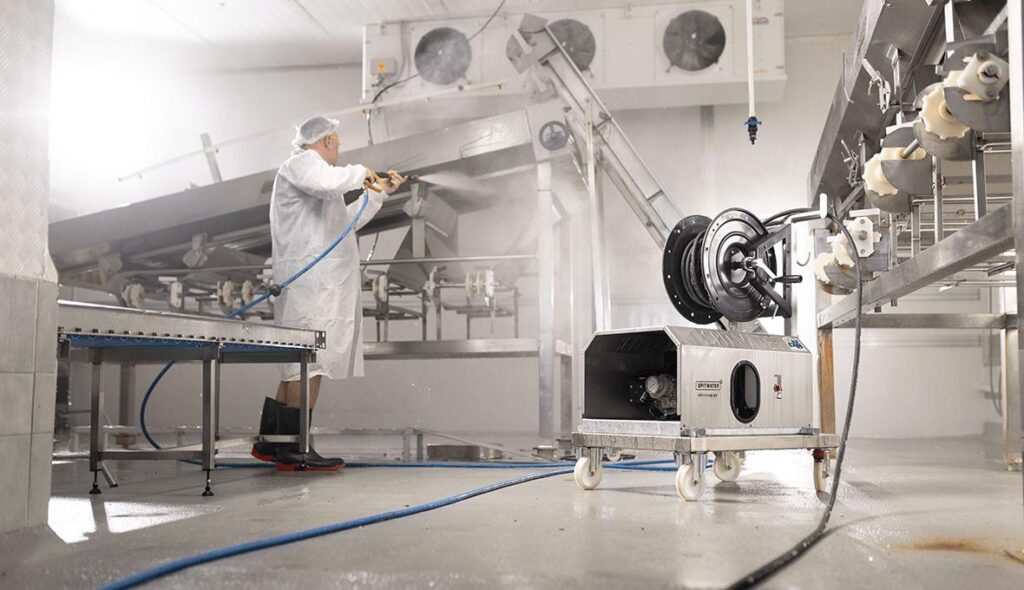
Consider what happens during a standard hot water washdown. If your facility washes down a processing room floor with water exceeding $160^\circ\text{F}$ ($71^\circ\text{C}$), a massive amount of thermal energy is transferred directly into the floor. Concrete and resinous coatings expand and contract at completely different rates when heated. If the coating is applied too thin, the intense shear stress at the bond line will literally tear the coating away from the concrete beneath it, causing bubbling, blistering, and delamination.
A thicker floor system acts as a structural buffer. It absorbs and dissipates that thermal energy safely, keeping the bond intact and protecting the underlying concrete slab from cracking.
The Industrial Flooring Thickness Blueprint
To help you navigate your options, industrial flooring systems are categorized into distinct thickness tiers based on the specific operational demands of different facility zones.
1. Light Duty Areas: 10 to 30 Mils (Thin-Mil Systems)
A “mil” is one-thousandth of an inch. Thin-mil systems are typically applied using rollers and act primarily as concrete sealers.
- Where to use: Employee break rooms, dry dry-goods storage warehouses, administrative offices, and dedicated pedestrian walkways.
- The Reality: These spaces don’t face extreme temperature swings, moisture pools, or chemical washdowns. A light-duty epoxy or polyurethane coating works perfectly here. It keeps the concrete dust-free, brightens up the workspace, and provides a slip-resistant surface that is easy for janitorial staff to sweep and mop.
2. Medium Duty Areas: 1/16 to 1/8 Inch
At this thickness range, coatings transition from thin roll-on paints to self-leveling slurries that are poured and troweled out.
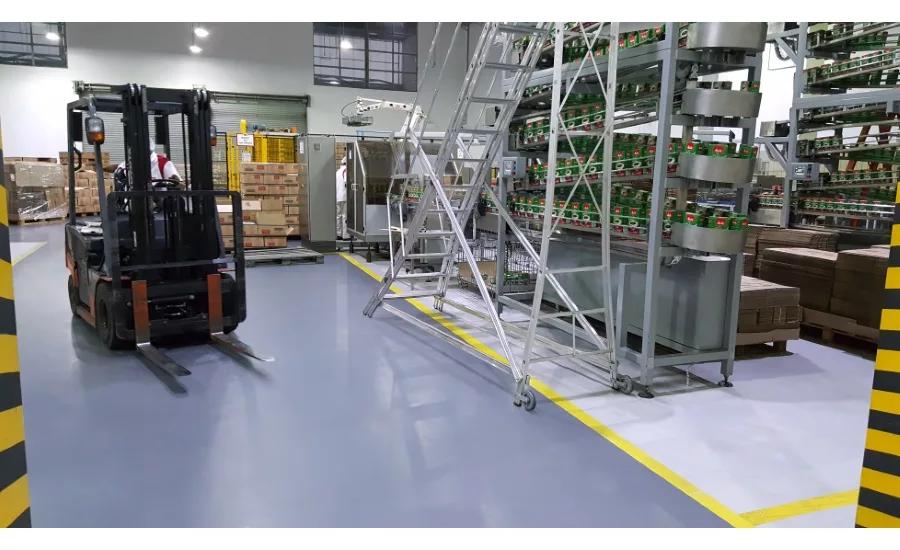
- Where to use: General packaging zones, assembly lines, automated bottling areas, and corridors with frequent forklift and pallet jack traffic.
- The Reality: If your floor needs to withstand the heavy point loads of loaded forklifts turning on a dime, or the occasional dropped metal tool, you need the added structural mass of a medium-duty floor. This thickness is thick enough to smooth out minor imperfections in the concrete substrate, creating a seamless surface that resists gouging and cracking.
3. Heavy Duty & Washdown Areas: 3/16 to 1/4 Inch
This is the absolute baseline standard for high-exposure food and beverage production zones where water and heat are constantly present.
- Where to use: Slaughterhouses, meat and poultry processing plants, commercial dairies, industrial bakeries, and craft breweries.
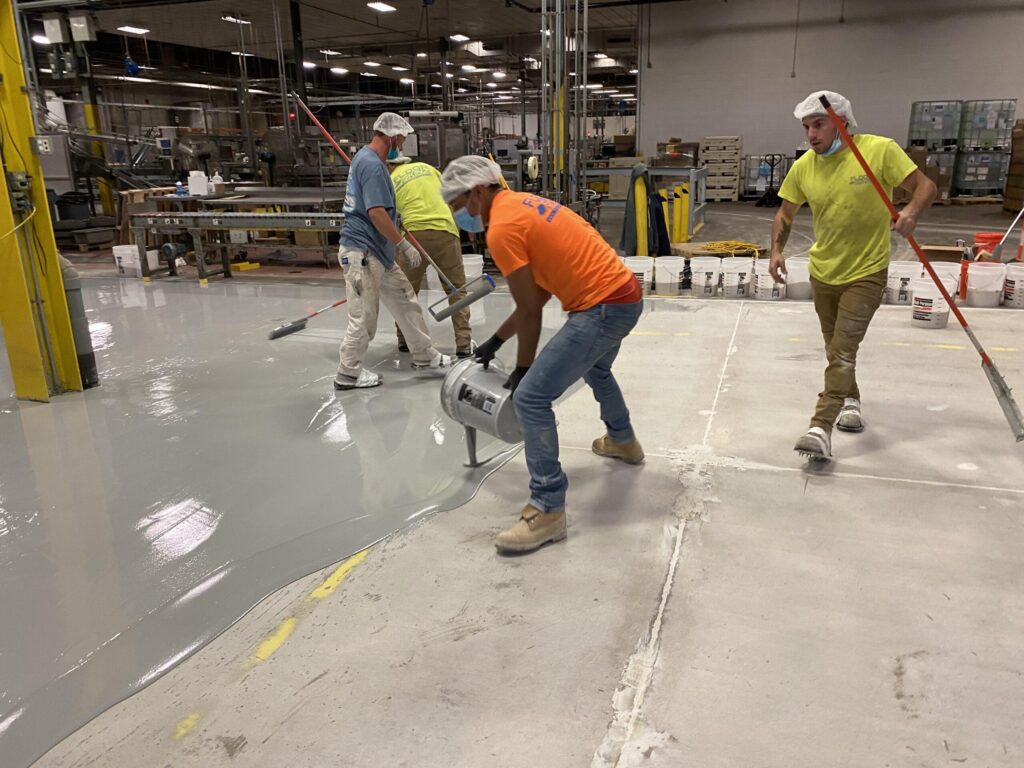
- The Reality: This is the realm where heavy-duty cementitious urethane takes center stage. At a full quarter-inch thickness, the floor possesses the physical mass required to survive daily thermal shock from steam cleaning or boiling wastewater discharge. It also handles aggressive chemical cleanings using harsh caustic solutions without breaking a sweat.
4. Extreme Duty Areas: 3/8 Inch and Above
When standard parameters aren’t enough, heavy trowel-applied mortar systems are required to handle extreme physical abuse.
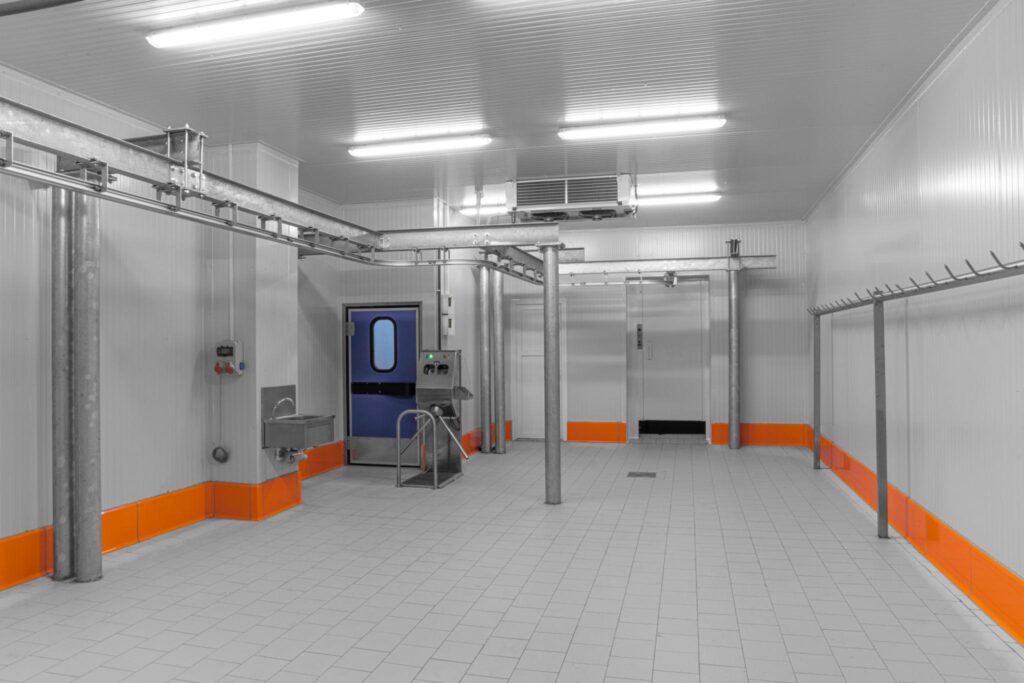
- Where to use: Blast freezers, deep-freeze storage environments, chemical containment dikes, and the concrete drainage trenches directly receiving boiling liquids.
- The Reality: These systems are virtually indestructible. They offer the highest possible resistance to continuous thermal cycles, severe impact, and high concentrations of organic acids (like lactic, citric, or acetic acids) that would easily eat through thinner coatings.
Why Cementitious Urethane Wins in Wet Processing
While standard epoxy is an exceptional material for wear resistance, it struggles in wet, high-heat food production environments. Epoxy is inherently rigid. Cementitious urethane (often called urethane cement), however, incorporates aggregate and cement technology that allows it to expand and contract at a rate that almost perfectly mimics the concrete beneath it. When you specify it at $1/4\text{-inch}$ thickness or greater, you are investing in a system designed to stay bonded to your slab for decades, eliminating the risk of microbial growth hiding under delaminated patches.
The Hidden Cost of Saving a Few Bucks
It is incredibly tempting to look at a flooring quote and think you can trim costs by dropping from a $1/4\text{-inch}$ system to a $1/8\text{-inch}$ system. In a food plant, that choice is almost always a false economy.
When a floor fails, it cracks and peels, creating open pockets where water pools and bacteria like Listeria can thrive. Once a health inspector flags a floor or a biological audit fails, your facility is facing unexpected, massive operational downtime. The cost of stopping production, removing thousands of pounds of heavy machinery, chipping out a failing floor, and doing the job right a second time will cost exponentially more than the initial savings.
Conclusion
Your facility’s floor isn’t just a surface to walk on; it is a critical piece of your production infrastructure. By accurately mapping out the thermal shocks, chemical loads, and physical impacts of each specific zone, you can choose the perfect thickness to maximize your investment.
Need help calculating the exact flooring thickness required for your food and beverage facility? Contact our technical team today for a custom site evaluation.